- This topic is empty.
-
AuthorPosts
-
2026-08-25 at 8:24 pm #89207
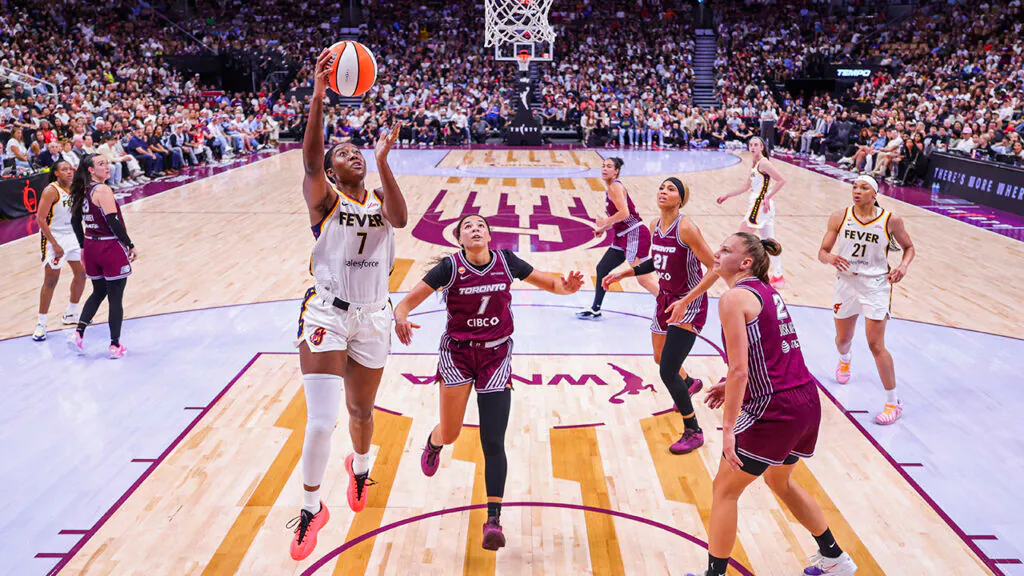
Watch a modern basketball game closely and you may notice something that has little to do with the players themselves: the lighting.
During the 2026 NBA Finals, ABC’s production used 1080p HDR capture and transmission, 52 cameras, 14 high-frame-rate super slow-motion cameras and native 4K high-frame-rate cameras. In other words, today’s basketball audience is not only watching the game in the arena — they are experiencing it through increasingly sophisticated cameras and screens.
That puts new demands on indoor basketball court lighting.
A lighting system now needs to do more than make the court bright enough for players to see. It needs to provide consistent illumination, minimize glare, perform well on camera, support slow-motion replay and create a comfortable visual environment for thousands of spectators.
So, if you are planning a new basketball facility or upgrading an existing gym, how do you choose the right LED sports lighting?
The answer starts with understanding what professional basketball actually requires.
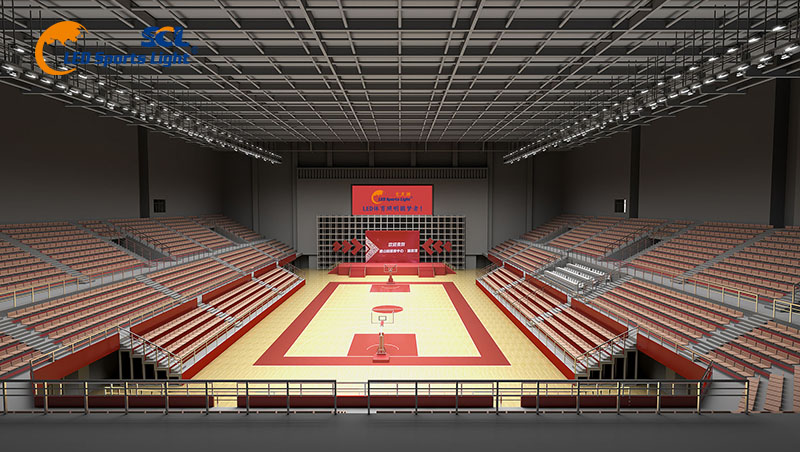
Why Indoor Basketball Lighting Has Become More Important
Basketball is one of the most visually demanding indoor sports.
The ball can move rapidly through the air, players frequently look upward and the action can change direction in a fraction of a second.
At the same time, modern venues have become multimedia environments.
A single basketball arena may need to support:
- Professional competition
- Training sessions
- School or university games
- Livestreaming
- Television broadcasting
- Photography
- Large LED displays
- Commercial events
This means lighting quality has to satisfy several different users at the same time.
Players need visual comfort.
Spectators need clear visibility.
Cameras need stable, uniform light.
Facility owners need energy efficiency and manageable maintenance costs.
That is why choosing basketball lighting should never be reduced to a simple comparison of wattage and lumen output.
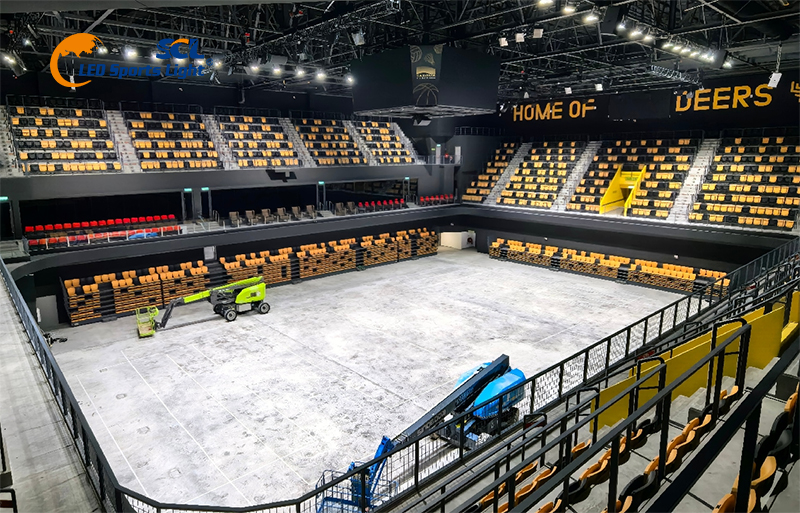
1. Start With the Competition Level
Before selecting any LED sport fixture, determine what level of basketball the venue is expected to host.
A community gym and an international competition arena have very different requirements.
FIBA’s current Venue Guide provides a useful example of this difference. For community facilities focused mainly on recreational participation, the recommended average horizontal illuminance can be around 300 lux. Competition venues without broadcasting requirements and elite practice facilities can require at least 750 lux, while venues intended for major competitions are recommended to reach around 3,000 lux horizontally.
For high-level venues, FIBA also highlights vertical illuminance, uniformity, glare, flicker, color rendering and color temperature as important parts of the lighting design.
This leads to a simple rule:
Choose the lighting system according to the highest level of competition you expect the venue to host — not just the events you host today.
Upgrading lighting after a sports hall has been completed can be expensive and disruptive.
2. Don’t Choose a Basketball Light Based on Lux Alone
Lux is important.
But average lux does not tell the whole story.
Imagine two courts that both have an average illuminance of 1,500 lux.
On the first court, the lighting is evenly distributed.
On the second, some areas are extremely bright while others are significantly darker.
The numerical average may be similar, but the visual experience will be very different.
This is why uniformity is critical.
When reviewing a basketball lighting proposal, look at:
- Average illuminance
- Minimum illuminance
- Horizontal uniformity
- Vertical illuminance
- Vertical uniformity
- Glare
- Light distribution
FIBA specifically notes that vertical illuminance uniformity is crucial in basketball venues, particularly for larger arenas.
A professional lighting simulation is therefore far more useful than simply comparing the lumen output of different fixtures.
3. Glare Can Affect Players More Than You Think
Basketball players spend a lot of time looking upward.
They track passes.
They watch rebounds.
They shoot.
They defend.
They follow the ball near the ceiling.
If a powerful luminaire is positioned directly within a player’s viewing direction, glare can become distracting.
FIBA’s guidance is particularly clear on this point: glare affecting players should be avoided, and luminaire positioning and aiming angles should be carefully considered. For its venue guidance, FIBA recommends an aiming angle around 45° from the downward vertical, with 60° indicated as a maximum in the relevant design context.
This is why professional basketball lighting relies heavily on optical design and fixture positioning.
A brighter fixture is not necessarily a better fixture.
The better question is:
Can the fixture deliver the required illumination without creating uncomfortable glare?
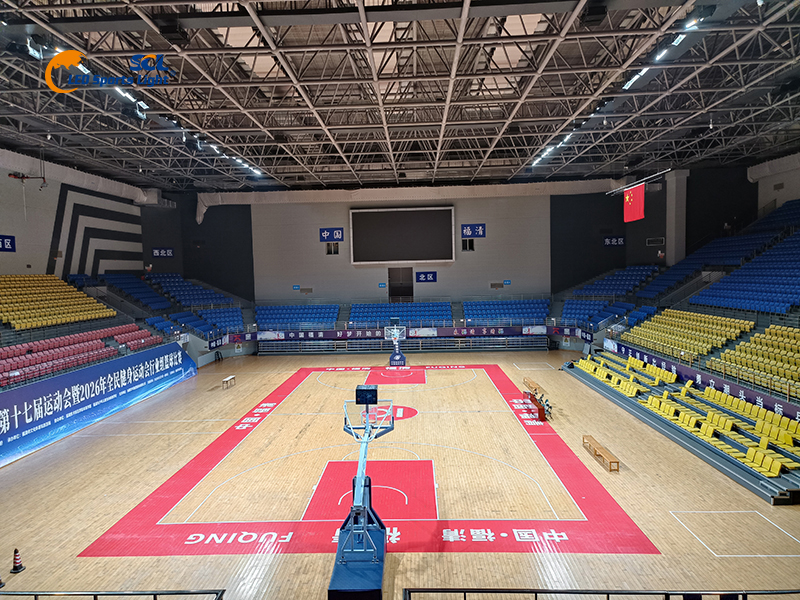
4. Optical Distribution Is One of the Most Important Decisions
Two LED sport fixtures can have exactly the same power rating and lumen output while producing completely different results on a basketball court.
The difference often comes down to optics.
A professional sports luminaire should be able to distribute light according to:
- Court dimensions
- Ceiling height
- Fixture mounting position
- Beam angle
- Player viewing directions
- Camera locations
- Required illuminance
This is particularly important in existing sports halls, where the designer may have limited mounting positions.
A good optical system can help reduce:
- Hot spots
- Dark areas
- Direct glare
- Reflected glare
- Unnecessary light spill
SCL Sports Lighting, for example, has developed a large library of independent light distribution schemes for sports lighting applications, allowing different optical solutions to be selected according to venue conditions.
This illustrates an important industry principle:
Professional sports lighting is a lighting-design problem, not simply a product-selection problem.
5. Vertical Illuminance Matters for Players and Cameras
Horizontal illuminance measures the light reaching the court surface.
But basketball does not happen only on the floor.
Players jump.
The ball rises.
Cameras capture players from different angles.
This is why vertical illuminance is especially important for high-level basketball facilities.
Good vertical illumination helps cameras capture:
- Faces
- Jerseys
- Player movement
- Jumping actions
- Ball trajectories
It also helps create a more consistent visual experience for spectators viewing the court from different positions.
FIBA’s venue guidance recommends around 1,700 lux average vertical illuminance for relevant high-level applications, while also emphasizing vertical uniformity.
For a broadcast-ready venue, therefore, the lighting calculation should not stop at the court floor.
6. Flicker Is a Camera Problem as Much as a Lighting Problem
Flicker may not always be obvious to spectators.
Cameras can tell a different story.
Modern basketball broadcasts use high-frame-rate cameras for slow-motion replay. Poor lighting flicker can create visible problems such as:
- Rolling bands
- Exposure fluctuations
- Color variations
- Uneven slow-motion images
FIBA’s equipment requirements identify flicker as an important lighting parameter and set a flicker factor of ≤1% in its stated requirements. FIBA also explains that flicker can negatively affect broadcast imagery, particularly during slow-motion footage.
This makes the LED driver just as important as the LED source.
When evaluating a sports lighting product, ask for actual flicker measurements rather than relying on general marketing terms such as “flicker-free.”
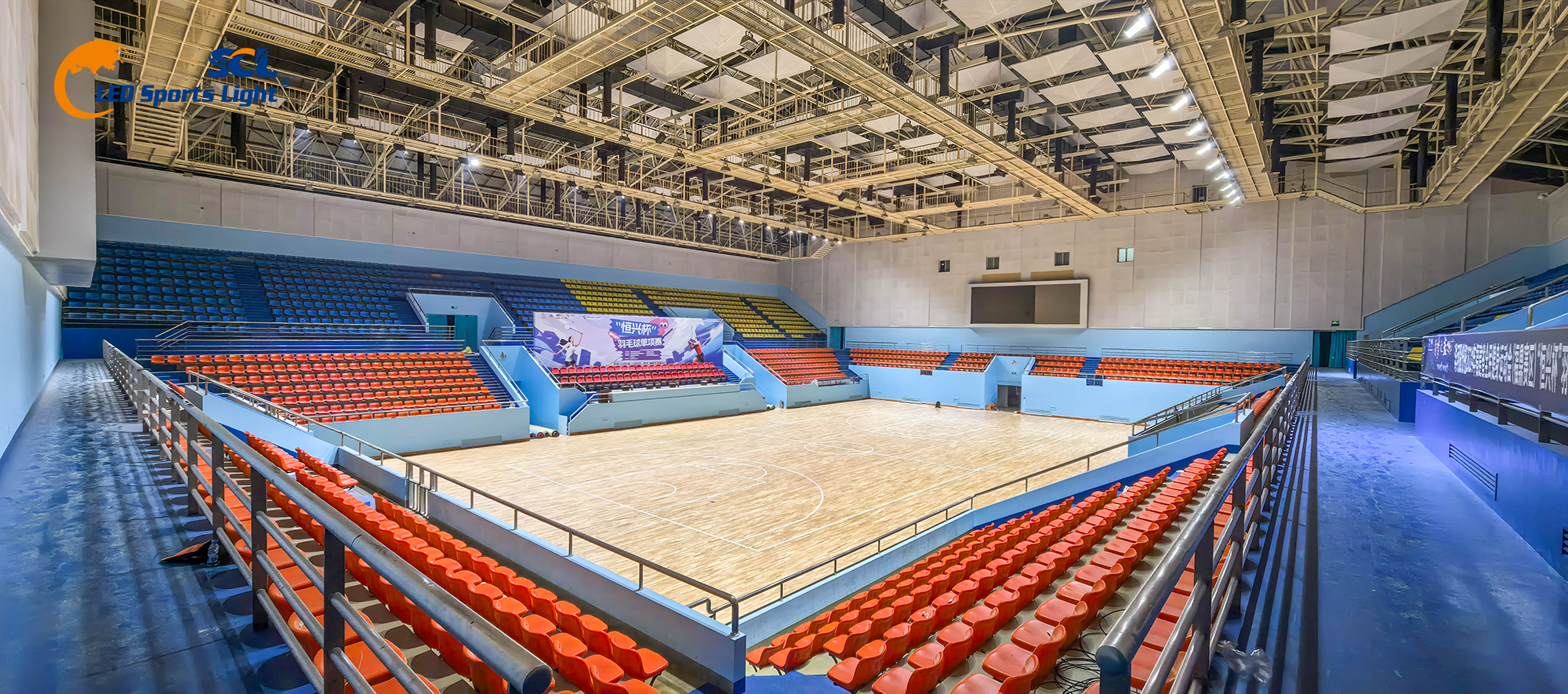
7. Color Rendering and Color Temperature Matter for Broadcasting
The quality of basketball broadcasts depends on more than brightness.
Players’ skin tones, team uniforms, the basketball and the wooden court all need to look natural.
FIBA’s stated lighting requirements include CRI ≥ Ra 80 and a color temperature range of 4,000–6,000 K for the relevant competition applications. It also notes that broadcasters require consistent color temperature.
For this reason, a professional sports lighting system should provide stable color performance across the entire court.
In practical terms:
The court should look consistent to the audience and to the camera.
8. Think About the Broadcast Before You Install the Lights
One of the biggest mistakes in sports venue design is treating broadcasting as an afterthought.
But modern basketball broadcasting is becoming increasingly sophisticated.
The 2026 NBA Finals are a good example. ABC’s production included 52 cameras, 14 high-frame-rate super slow-motion cameras and four native 4K high-frame-rate cameras.
While a local basketball gym obviously does not need an NBA-level production setup, the trend is important.
Even smaller venues increasingly use:
- Livestreaming
- High-definition cameras
- Social media video
- Automated replay
- Player highlights
- Online tournaments
Lighting that looks acceptable to the naked eye may therefore perform differently on camera.
If a venue will be filmed, the lighting should be designed with the cameras in mind from the beginning.
9. Energy Efficiency Is About More Than Replacing Metal Halide Lamps
Many older sports halls still rely on traditional discharge lighting.
Replacing these systems with LED sports lighting technology can provide advantages such as:
- Lower energy consumption
- Instant start-up
- Better dimming capability
- Longer service life
- Reduced maintenance
- More precise optical control
But the biggest opportunity comes from combining LED sports lighting technology with intelligent control.
A basketball venue does not need to operate at competition-level lighting every hour of the day.
For example:
Training Mode
Reduced lighting level for regular practice.
Competition Mode
Higher lighting level for official games.
Broadcast Mode
Optimized lighting for camera performance.
Maintenance Mode
Lower lighting levels for cleaning and facility operations.
This allows the venue to use energy according to actual requirements rather than operating every fixture at full power continuously.
10. A Real Project Is Often More Useful Than a Product Datasheet
When comparing sports lighting suppliers, ask to see actual basketball projects.
Why?
Because sports lighting is affected by the complete environment.
The same fixture may perform differently depending on:
- Mounting height
- Court size
- Ceiling structure
- Fixture spacing
- Beam angle
- Wall color
- Floor reflectance
- Camera positions
SCL’s basketball lighting experience includes projects such as the 2022 NBL All-Star Game, where the lighting system was designed for HDTV broadcasting requirements.
The company has also worked on basketball and multi-purpose sports venues designed for different combinations of competition, training and broadcasting.
The important lesson is not simply that one manufacturer has completed a particular project.
It is that the supplier should be able to demonstrate how its lighting design was adapted to the venue.
11. Ask for the Lighting Simulation Before You Sign the Purchase Order
A professional basketball lighting project should begin with a lighting calculation.
At minimum, provide the supplier with:
- Court dimensions
- Ceiling height
- Mounting positions
- Existing lighting layout
- Competition level
- Broadcasting requirements
- Camera positions
Then ask for a simulation showing:
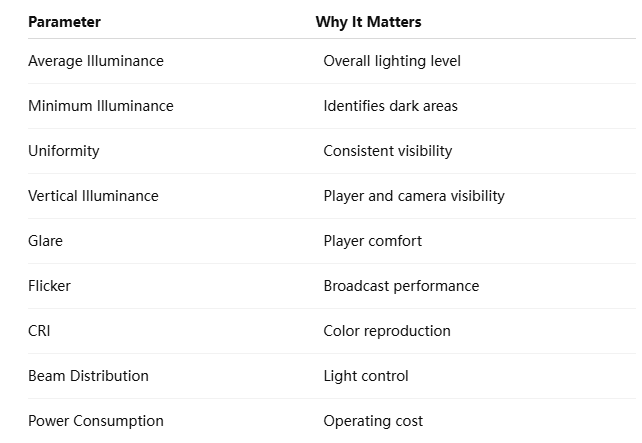
If a supplier cannot clearly explain how its proposed lighting system achieves the required results, that should be a warning sign.
12. What Should You Ask an LED Sports Lighting Supplier?
Before choosing a supplier, ask these questions:
1. What competition level is the system designed for?
2. What average and minimum illuminance can the system achieve?
3. What are the horizontal and vertical uniformity values?
4. What is the flicker factor of the complete luminaire?
5. What is the CRI and color temperature?
6. How is glare controlled?
7. What beam angles are available?
8. Can the lighting system support livestreaming or professional broadcasting?
9. Can different lighting modes be programmed?
10. Will the supplier provide a professional lighting simulation?
These questions will help you compare suppliers based on performance rather than marketing claims.
13. One More Thing: Think About Future Events
A sports venue can have a very long life.
Today’s community basketball court could become tomorrow’s regional competition venue.
Today’s training hall could later host professional league games.
Today’s local tournament could eventually require livestreaming and television coverage.
FIBA’s Venue Guide therefore recommends that permanent sports lighting systems be designed around the maximum competition requirements the venue expects to host, because replacing or upgrading lighting later can be difficult and expensive.
A slightly more capable lighting system today may therefore be much more economical than a complete lighting upgrade five years later.
Final Takeaway
Choosing LED sports lighting for an indoor basketball court is not simply a matter of finding the brightest fixture.
A good system needs to balance:
Illuminance + Uniformity + Glare Control + Vertical Illumination + Flicker + Color Quality + Optics + Energy Efficiency
And increasingly:
Lighting + Cameras + Broadcasting + Intelligent Control
The best solution is the one that fits the venue’s actual requirements.
For a community gym, that may mean comfortable and efficient lighting.
For a professional arena, it may mean high uniformity, low flicker, controlled glare and broadcast-ready performance.
For a multi-purpose sports center, flexibility and intelligent control may be just as important as raw illumination.
As basketball continues to evolve into a highly produced media experience, the lighting above the court is becoming part of the technology behind the game.
The players create the moments. Good lighting makes sure everyone can see them — in the arena, on the broadcast and in the replay.
About the Industry Example
SCL Sports Lighting is one example of a specialist manufacturer working in this field. With more than 18 years of experience in sports lighting, the company has developed LED sports lighting solutions for basketball, football, tennis, badminton and other sports facilities, with projects across international markets.
Its basketball-related projects illustrate the importance of combining optical design, lighting simulation, installation layout and intelligent control, rather than treating the LED sport luminaire as an isolated product.
For anyone evaluating basketball court lighting suppliers, the broader lesson is simple:
Look for lighting expertise, not just lighting products.
https://www.stadiumlight.com/
GUANGDONG SEVEN CONTINENTS INDUSTRIAL CO., LTD -
AuthorPosts

- You must be logged in to reply to this topic.