- This topic is empty.
-
AuthorPosts
-
2026-08-26 at 9:47 pm #89213
Rugby is one of the most physically demanding team sports in the world.
The players move rapidly across a huge field, the ball can travel through the air at unpredictable angles, and a single match can involve intense action from one end of the stadium to the other.
Now imagine watching all of that under poor stadium lighting.
A player struggles to track a high kick.
A camera loses detail during a fast break.
Spectators experience uncomfortable glare.
Dark areas appear around the field.These problems are easy to overlook during daytime games, but they become critical when a stadium hosts evening matches or televised events.
And rugby is entering an increasingly important period.
In 2026, the rivalry between the New Zealand All Blacks and South Africa Springboks is attracting major international attention, while preparations are already underway for the 2027 Rugby World Cup in Australia. The 2027 tournament will feature 24 teams and 52 matches across seven Australian host cities.
For stadium owners and sports facility managers, this creates an interesting question:
How should you choose LED sport lighting for a rugby stadium?
The answer involves much more than simply selecting high-power floodlights.
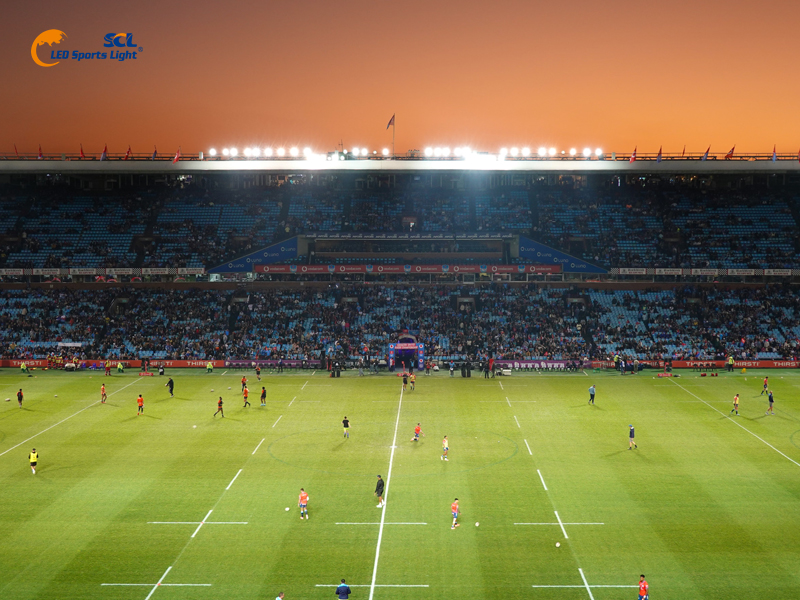
1. Rugby Lighting Is Different From Ordinary Floodlighting
A rugby pitch is large.
A standard outdoor rugby pitch can be around 144 × 69 metres, meaning the lighting system needs to cover a significantly larger area than many other sports facilities.
But size is only part of the challenge.
Rugby also involves:
· High-speed running
· Long-distance passes
· High kicks
· Scrums and lineouts
· Rapid changes in direction
· Players spread across a large field
· Action occurring at different heights
The lighting therefore needs to provide good visibility across the entire playing area.
This means a rugby stadium should not be treated like a general outdoor space that simply needs to be “bright.”
It needs a professional sports lighting design.
2. Start With the Level of Rugby Competition
Not every rugby stadium needs the same lighting system.
A community rugby field may primarily host local matches and training.
A professional stadium may need to support:
· League matches
· International fixtures
· Night games
· Television broadcasting
· Livestreaming
· Commercial events
· Large spectator audiences
The required lighting level can therefore vary significantly.
As a useful industry reference, lighting guidance for outdoor rugby pitches commonly divides facilities into different classes. One current sports-lighting application guide lists approximately:
Rugby Pitch Class
Average Horizontal Illuminance
Uniformity
Class I
500 lux
≥ 0.70
Class II
200 lux
≥ 0.60
Class III
75 lux
≥ 0.50
These figures are useful as a starting point, but the actual design should always be based on the applicable local, competition and broadcasting requirements.
For a professional stadium, broadcasting requirements can become much more demanding than ordinary training or community use.
3. Don’t Choose Rugby Stadium Lights by Wattage
This is one of the most common mistakes when upgrading stadium lighting.
A buyer may compare:
1,000W vs. 1,500W vs. 2,000W
and assume that the highest wattage must provide the best result.
Not necessarily.
A stadium lighting system depends on:
· LED sports efficiency
· Beam angle
· Optical distribution
· Mounting height
· Mast position
· Aiming angle
· Number of luminaires
· Field dimensions
· Required uniformity
· Camera locations
A well-designed 1,000W system may outperform a poorly designed 2,000W system.
The better question is:
How efficiently does the system deliver the required illumination across the field?
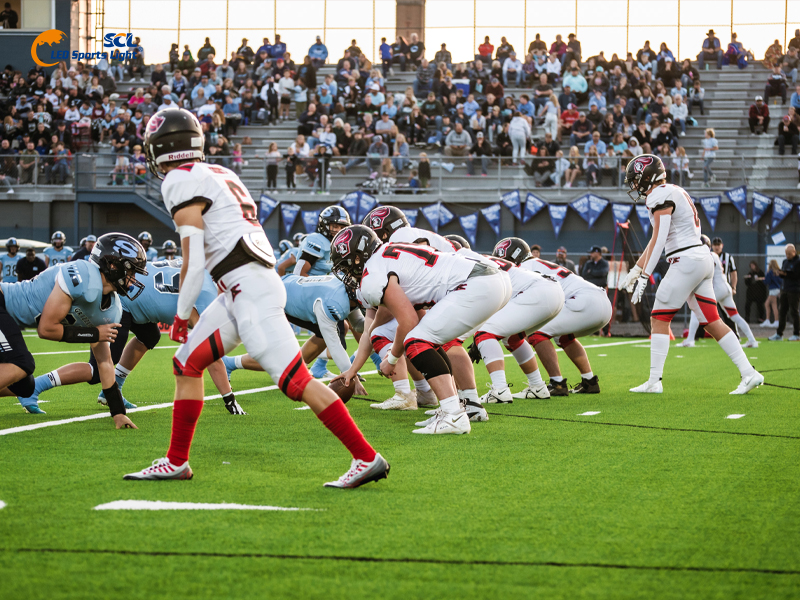
4. Uniformity Is Critical on a Rugby Pitch
Rugby is played over a very large area.
If one part of the field is significantly brighter than another, players may experience changes in visual conditions as they move across the pitch.
This can become particularly noticeable when tracking:
· High kicks
· Long passes
· Cross-field movements
· Players running from shadowed areas into brightly illuminated areas
For spectators, uneven lighting can also make the stadium look visually inconsistent.
For cameras, it can create exposure differences across the field.
This is why a professional rugby lighting project should evaluate:
Average illuminance + Minimum illuminance + Uniformity
rather than focusing only on average lux.
5. High Kicks Make Vertical Visibility Important
This is one of the more interesting characteristics of rugby lighting.
The ball doesn’t stay close to the ground.
A high kick can send the ball far above the playing surface before players compete for possession.
Therefore, the lighting design needs to consider more than horizontal illumination.
Vertical illumination matters.
Players need to be able to track the ball against different backgrounds.
Cameras also need sufficient illumination to capture players and the ball from different viewing directions.
This is especially important for professional stadiums where matches are broadcast internationally.
A stadium can therefore have acceptable horizontal illuminance while still having problems with the visual quality of the action above the pitch.
6. Glare Control Should Be a Priority
Stadium floodlights are extremely powerful.
If their aiming angles are poorly designed, they can create significant glare for:
· Players
· Goalkeepers/fullbacks
· Officials
· Spectators
· Television cameras
This is particularly important in rugby because players frequently look upward to track the ball.
Professional stadium lighting design therefore needs to carefully consider:
Mast Position → Mounting Height → Beam Angle → Aiming Angle → Player Viewing Direction
Modern LED sports technology provides much more precise optical control than older discharge lighting systems, but this also means poor aiming can create intense localized glare.
FIFA’s stadium lighting guidance, although developed for football, illustrates the broader principle applicable to large-field sports: stadium lighting needs to balance horizontal illumination, vertical illumination, glare, colour rendering, camera positions and spill light. It also recommends careful consideration of mounting geometry, aiming angles and beam characteristics.
For rugby, the same design philosophy is highly relevant.
More powerful does not mean better if the light is pointing in the wrong direction.
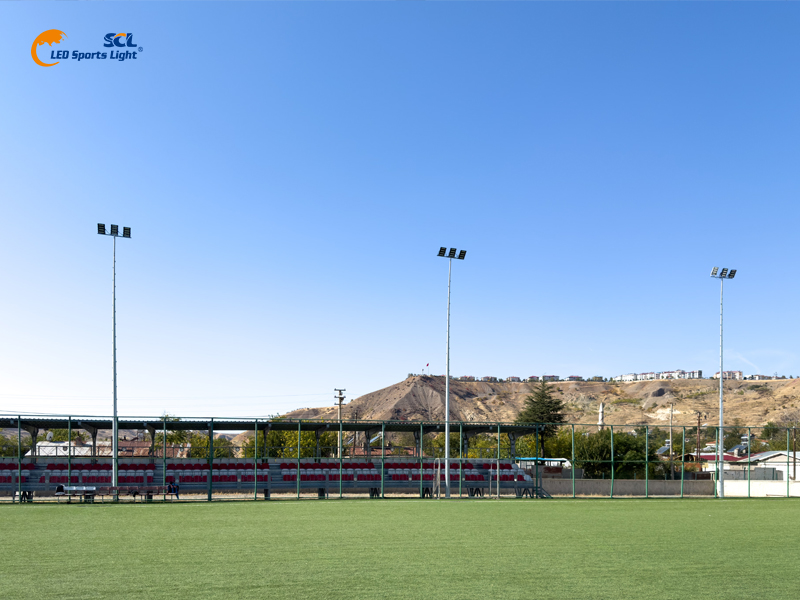
7. Broadcasting Is Changing Rugby Stadium Lighting
This may become one of the biggest reasons for stadium lighting upgrades.
Modern rugby is no longer watched only from the stands.
Fans increasingly watch matches through:
· Television
· Streaming platforms
· Mobile phones
· Social media
· Highlight videos
· Slow-motion replay
The 2026 All Blacks vs. Springboks rivalry is a good example of how international rugby has become a major global media product. The current series is part of a broader SANZAAR international calendar and is receiving extensive international broadcast coverage.
That means stadium lighting needs to work for cameras as well as people.
For broadcast-ready venues, lighting designers should consider:
· Vertical illuminance
· Uniformity
· Flicker
· Colour rendering
· Colour temperature
· Shadow control
· Camera viewing directions
The field may look perfectly bright to spectators while still producing poor images on camera.
8. Flicker Is a Hidden Problem for High-Speed Cameras
This is particularly important for professional rugby.
Modern broadcasts increasingly use high-frame-rate cameras to capture:
· Tackles
· Tries
· High kicks
· Scrums
· Breakaway runs
· Slow-motion replays
A lighting system with poor flicker performance may produce visual artifacts that are not obvious to the human eye.
Possible problems include:
· Rolling bands
· Exposure variations
· Inconsistent brightness
· Colour fluctuations
· Poor slow-motion footage
For a stadium expecting television or high-quality livestreaming, flicker performance should be tested as part of the complete lighting system.
Do not simply rely on the phrase “flicker-free” in a product brochure.
Ask for measurable data.
9. Colour Quality Matters More Than You Might Expect
Rugby stadiums contain a lot of visual information.
Players wear different coloured jerseys.
The field has natural green tones.
Advertising boards and digital screens surround the pitch.
Spectators are constantly visible in the background.
Poor colour quality can make the entire stadium appear unnatural on camera.
For professional applications, the lighting system should therefore provide:
· Stable colour temperature
· Good colour rendering
· Consistent performance between fixtures
· Minimal colour variation across the field
This becomes even more important when multiple cameras are filming from different locations.
10. LED Sports Lighting Technology Gives Rugby Stadiums More Control
Traditional metal halide stadium lights can provide high output, but they are less flexible in terms of modern lighting control.
LED sports lighting offers several advantages:
Instant ON/OFF
Useful for stadium operations and events.
Dimming
Lighting levels can be adjusted according to actual use.
Better Optical Control
Modern LED sport optics can direct light more precisely.
Lower Energy Consumption
Less electricity is required for equivalent lighting performance in many applications.
Longer Service Life
Maintenance intervals can potentially be extended.
Intelligent Control
Different lighting scenes can be programmed for different events.
A rugby stadium could potentially use different modes for:
Training
↓
Local Match
↓
Professional Match
↓
Broadcast Match
↓
Opening Ceremony / Event
This makes the lighting system part of the stadium’s wider operational infrastructure rather than simply a collection of floodlights.
11. Light Spill Is Becoming a Bigger Issue
Large rugby stadiums are often surrounded by:
· Residential areas
· Roads
· Commercial buildings
· Parks
· Public spaces
Poorly controlled floodlighting can create unwanted light outside the stadium.
This can lead to:
· Residential complaints
· Excessive sky glow
· Environmental concerns
· Reduced neighbourhood comfort
Modern sports lighting therefore needs to consider where the light does not go, as well as where it does.
This is another area where modern LED sport optics can provide an advantage.
Precise beams can help reduce unnecessary spill while maintaining the required illumination on the field.
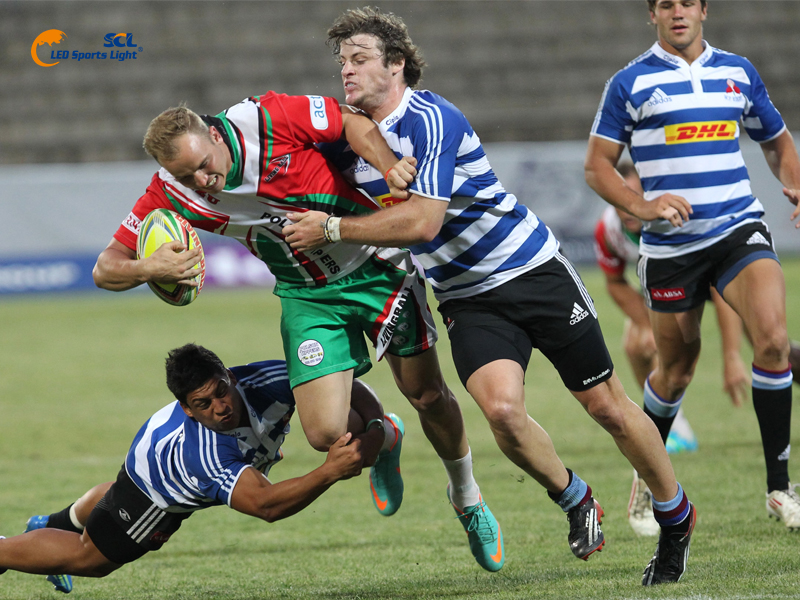
12. Weather Resistance Matters for Rugby Stadiums
Unlike indoor sports, rugby lighting is exposed to the elements.
A professional outdoor LED sport floodlight needs to deal with:
· Rain
· Humidity
· Dust
· Wind
· Temperature changes
· Lightning and electrical surges
When evaluating outdoor stadium lights, look at:
IP Rating
Protection against water and dust.
IK Rating
Resistance to mechanical impact.
Thermal Management
Important for maintaining LED sports and driver performance.
Surge Protection
Especially relevant in large outdoor installations.
For stadium projects, reliability is just as important as light output.
A floodlight that performs well in the first month but becomes unreliable after several seasons is not a successful lighting solution.
13. Why Rugby Stadium Lighting Should Be Designed Before Buying Fixtures
A rugby stadium is too large and too complex for a simple “fixture replacement” approach.
The correct process should look more like:
Field Survey
↓
Competition & Broadcast Requirements
↓
Mast Position Analysis
↓
Lighting Simulation
↓
Optical Selection
↓
Aiming Angle Design
↓
Energy Calculation
↓
Installation
↓
Commissioning
This is why choosing an experienced sports lighting supplier is important.
The fixture is only one part of the system.
14. Where SCL Sports Lighting Fits Into the Opportunity
Although SCL Sports Lighting has built its experience around professional sports lighting rather than a large portfolio of rugby-specific projects, the technical requirements of rugby overlap significantly with those of other large-field sports.
SCL’s sports lighting solutions focus on areas such as:
· Professional optical design
· Anti-glare control
· High uniformity
· LED sports lighting thermal management
· Intelligent lighting control
· Lighting simulation
· Installation guidance
· Commissioning
Its existing sports lighting work covers large outdoor venues and sports including football, tennis and other professional applications.
That experience can be relevant when developing a rugby lighting solution because many of the underlying challenges are the same:
Large playing area + long viewing distances + high mounting positions + glare control + broadcasting + energy efficiency.
For a rugby facility looking to upgrade from traditional floodlighting to LED sports lighitng, this kind of cross-sport lighting experience can be valuable.
And importantly, any rugby project should still be designed specifically for the rugby field rather than simply copying a football lighting layout.
15. Rugby Stadiums Have a Major Opportunity Ahead
The timing is particularly interesting.
The 2027 Rugby World Cup in Australia will be the largest edition of the men’s tournament to date, featuring 24 teams and 52 matches across seven host cities.
Meanwhile, the 2026 international calendar is already giving rugby fans a number of major fixtures, including the Nations Championship and the highly anticipated All Blacks–Springboks series.
This creates opportunities beyond the major tournament venues themselves.
Training facilities, regional stadiums, university rugby grounds and professional clubs may all need to improve their infrastructure to support:
· Night matches
· Professional training
· Broadcast-quality video
· International visitors
· Commercial events
· Energy-saving targets
In other words:
The demand for professional rugby lighting is not limited to World Cup stadiums.
16. What Should You Ask a Rugby Lighting Supplier?
Before purchasing LED stadium lights, ask:
1. Can you provide a professional lighting simulation?
A serious sports lighting supplier should be able to demonstrate the expected result.
2. What uniformity can you achieve?
Average lux alone is not enough.
3. How do you control glare?
Ask about optical design, mounting positions and aiming angles.
4. Is the system suitable for television broadcasting?
Ask specifically about vertical illumination, flicker and colour consistency.
5. What lighting modes can be programmed?
Training and competition should not necessarily use the same lighting level.
6. What is the energy consumption of the complete system?
Compare the whole installation rather than individual fixtures.
7. How is light spill controlled?
This is especially important for stadiums near residential areas.
8. What environmental protection does the fixture provide?
Check IP, IK, thermal management and surge protection.
9. Can the system be expanded or upgraded?
A stadium may have different requirements in five or ten years.
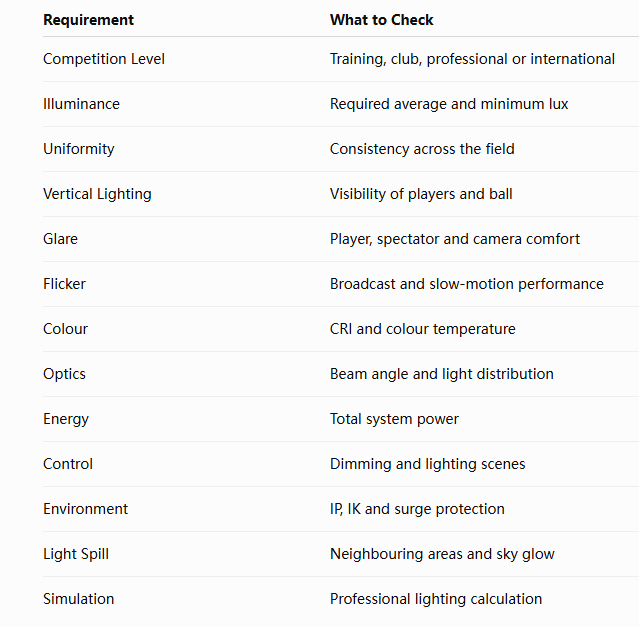
Rugby Stadium Lighting: A Simple Checklist
If you’re planning a rugby stadium lighting upgrade, start with these questions:
Final Thoughts
Rugby is moving into an increasingly sophisticated era.
The sport is becoming more global, more heavily broadcast and more technologically advanced.
The current All Blacks vs. Springboks rivalry shows the international appeal of the sport, while the upcoming 2027 Rugby World Cup in Australia is set to bring even greater attention to rugby stadiums around the world.
For stadium owners, this means lighting can no longer be treated simply as infrastructure that turns on after sunset.
It has become part of the performance, broadcast and spectator experience of the stadium.
The best rugby stadium LED sports lighting system is therefore not necessarily the one with the highest wattage.
It is the one that delivers:
The right light + The right uniformity + The right optical control + The right camera performance + The right energy efficiency.
And as more rugby matches move into prime-time and broadcast environments, professional LED sports lighting will become an increasingly important part of the modern rugby stadium.
The game happens on the field. But good lighting makes sure every tackle, pass, kick and try can be seen.
https://www.stadiumlight.com/
GUANGDONG SEVEN CONTINENTS INDUSTRIAL CO., LTD -
AuthorPosts

- You must be logged in to reply to this topic.