- This topic is empty.
-
AuthorPosts
-
2026-09-29 at 10:43 am #89546
Photovoltaic power plants are increasingly distributed across rooftops, industrial sites, agricultural land, remote areas, and large utility-scale installations. Although the panels and inverters generate the electricity, a separate communications network is needed to turn equipment data into useful information for operators.
A modern PV monitoring system may collect inverter status, power output, voltage, current, energy production, environmental measurements, alarms, and other operating data. Monitoring standards such as IEC 61724-1 address the equipment, terminology, and methods used for photovoltaic system performance monitoring and analysis.
For many solar installations, particularly remote or distributed sites, connecting this information to a monitoring platform can be difficult. There may be no fixed broadband connection, the electrical infrastructure may be widely spread across the site, and access for maintenance personnel may be limited.
This is where an industrial 5G router for photovoltaic power monitoring can provide a practical communications solution.
Rather than treating the router simply as a device that provides internet access, a well-designed industrial router can serve as the communications gateway between inverters, meters, sensors, local control equipment, edge devices, and a central monitoring platform.
For solar operators and system integrators, the real question is therefore not only whether 5G is available. It is whether the industrial router can maintain reliable communication with field equipment, handle the required data traffic, provide secure remote access, and continue operating in the physical environment where the PV equipment is installed.
Why Communication Is Critical in PV Power Monitoring
Solar generation is affected by changing irradiance, temperature, weather, equipment condition, and grid operating conditions. As a result, simply knowing that a PV plant is producing electricity is not enough for effective operation and maintenance.
The monitoring system needs regular and reliable data.
The U.S. Department of Energy notes that PV monitoring platforms can collect electrical measurements such as real power, reactive power, voltage, and current, while environmental information can include incident sunlight, ambient temperature, and PV module temperature.
For operators, this data can be used to identify abnormal production, compare measured output with expected performance, investigate equipment faults, and support ongoing maintenance.
IEC 61724-1:2021 provides a framework for photovoltaic performance monitoring and includes updated considerations for monitoring equipment and photovoltaic system analysis.
When a solar site is connected through an unstable communications link, however, the monitoring platform may receive incomplete data even when the PV equipment itself is operating normally.
That makes the communications gateway an important part of the monitoring architecture.
The Typical Data Path
A practical remote PV monitoring network may look like this:
PV modules → Inverters and meters → Industrial network → 5G industrial router → Mobile network → Monitoring platform or control centre
Depending on the project, local PLCs, data loggers, weather stations, cameras, or edge computers may also be connected.
The router therefore sits at the point where field data leaves the solar installation and enters the wider communications network.
What to Look for in an Industrial 5G Router for PV Monitoring
A solar monitoring project has different requirements from a conventional office network. The router should be selected according to the characteristics of the PV site, the connected equipment, and the monitoring architecture.
Stable Cellular Connectivity
Many photovoltaic sites are located outside urban centres, where deploying fibre or other fixed connections may be more difficult.
A 5G industrial router gives project engineers another option for connecting remote equipment to the monitoring platform without waiting for fixed telecommunications infrastructure.
5G is particularly useful when a site needs higher data capacity or when the communications architecture is expected to support additional applications in the future. The router can provide a cellular backhaul while the local industrial network connects the inverters, meters, sensors, and other devices.
The important point is that the 5G connection should be considered as part of the entire site communications design rather than as an isolated specification.
Dual SIM for Network Redundancy
A PV monitoring system may need to remain accessible even when the primary mobile network becomes unavailable.
E-Lins’ industrial 5G router portfolio includes dual-SIM configurations, and the H900f is positioned with dual-SIM hot backup for critical industrial connectivity. This enables an alternative mobile connection to be used when the primary connection encounters a service interruption.
For distributed solar sites, this can be valuable because a network fault does not necessarily justify sending a technician to the plant.
A typical arrangement can use:
Connectivity function Example configuration Primary cellular connection SIM 1 Backup cellular connection SIM 2 Local equipment network Gigabit Ethernet Remote communication VPN Central management NMS / SNMP / other supported management tools The exact failover configuration should be based on available mobile networks and project requirements.
Connecting Inverters, Meters and Industrial Equipment
PV monitoring is rarely limited to a single device.
A solar installation can include multiple inverters, electrical meters, weather sensors, data acquisition devices, controllers, and other equipment. Large sites can therefore place a significant number of data endpoints behind a single communications gateway.
This is where interfaces and protocol compatibility become important.
E-Lins supports Modbus, TCP/IP, and industrial serial transparent transmission within its industrial communication portfolio. These capabilities are relevant where the monitoring architecture needs to communicate with industrial equipment using established field interfaces.
For example, an installation may contain legacy equipment communicating through RS232 or RS485 while newer devices use Ethernet.
A communications architecture may therefore look like:
RS485 equipment + Ethernet equipment → Local data collection → E-Lins industrial router → 5G backhaul → Remote monitoring platform
The router does not need to replace the site’s existing control architecture. Instead, it can provide the communications bridge that connects those systems to the remote monitoring environment.
Why Protocol Support Matters
Using a router with suitable industrial connectivity can avoid unnecessary changes to field equipment.
This is especially useful for solar projects that expand over time. A site may begin with a limited number of monitored assets and later add additional meters, environmental sensors, cameras, or control devices.
A flexible network gateway can make those additions easier to integrate.
Remote Solar Sites Need Industrial-Grade Hardware
PV installations often expose communications equipment to operating conditions that are very different from an indoor IT room.
A router may be installed inside an outdoor electrical cabinet, at a remote equipment shelter, or near field devices where temperatures can change significantly.
E-Lins specifies industrial-grade chips and components with a -35°C to +75°C wide temperature tolerance, together with 15KV ESD protection and 1.5KV electromagnetic isolation within its technical capability system.
These specifications are relevant for PV monitoring because the communication gateway can be exposed to temperature changes, electrical interference, and other environmental conditions at the installation site.
The objective is simple: the monitoring connection should be designed around the physical environment instead of assuming that an office router will perform equally well in a field cabinet.
E-Lins focuses specifically on industrial M2M and IoT wireless communication equipment for unattended and distributed environments, which aligns with the operating characteristics of remote photovoltaic assets.
Remote Management Is Important for Solar Portfolios
A single solar plant may be manageable through occasional onsite maintenance. A portfolio of distributed PV installations creates a different challenge.
An operator may need to monitor communications equipment across dozens or hundreds of locations.
E-Lins supports TR-069, SNMP, SSH, and NMS cloud platforms for centralized management. Its NMS approach is intended to support monitoring, configuration, updating, diagnosis, maintenance, management, and control of distributed communication terminals.
This can be particularly useful for photovoltaic portfolios.
Monitor Router Availability
Before investigating why a monitoring platform has stopped receiving inverter data, engineers can first determine whether the communications gateway itself is online.
Diagnose Communication Problems Remotely
Remote troubleshooting can help distinguish between a cellular issue, router issue, and downstream device issue.
Standardize Multiple Sites
A centralized management system can make it easier to maintain consistent configurations across a distributed PV portfolio.
Reduce Unnecessary Site Visits
When software or connectivity faults can be investigated remotely, maintenance teams can avoid travelling to a site simply to determine whether the router has lost its connection.
E-Lins also provides 7×24-hour remote technical support, including packet capture analysis and remote debugging, as part of its service model.
Security for Remote Photovoltaic Monitoring
PV monitoring networks should not be treated as open communication channels.
Remote access can expose industrial devices and operational information if the network architecture is poorly designed. A suitable industrial router should therefore support secure communications between the remote site and authorized users or central systems.
E-Lins supports VPN technologies including WireGuard, IPsec, and OpenVPN. These can be used to establish protected communication paths for remote monitoring and maintenance.
The final security design will depend on the project’s IT and OT architecture. Network segmentation, authentication, firewall rules, private APN or similar cellular networking arrangements, and access permissions should all be considered as part of the complete design.
The router is one security component rather than a substitute for the full cybersecurity architecture.
Using a 5G Router for More Than Basic PV Monitoring
One benefit of selecting an industrial 5G router is that the communications infrastructure can potentially support more than inverter data.
A solar site may also use network connectivity for:
-
Environmental monitoring
-
Remote electrical equipment access
-
Security surveillance
-
Edge computing
-
Equipment diagnostics
-
Industrial sensors
-
Local automation
-
Site networking
This is particularly relevant to newer solar projects where the communications network is expected to support several digital functions.
For example, an edge computer could collect and preprocess data locally while the 5G router provides the backhaul to a cloud platform. This architecture can reduce the need to treat the router as the location where all processing takes place.
The concept also aligns with the broader development of distributed energy monitoring, where operators increasingly use measured production and environmental data to assess PV system performance. The U.S. Department of Energy has used production data together with irradiance and ambient temperature information to evaluate PV system performance and key indicators such as availability and performance ratio.
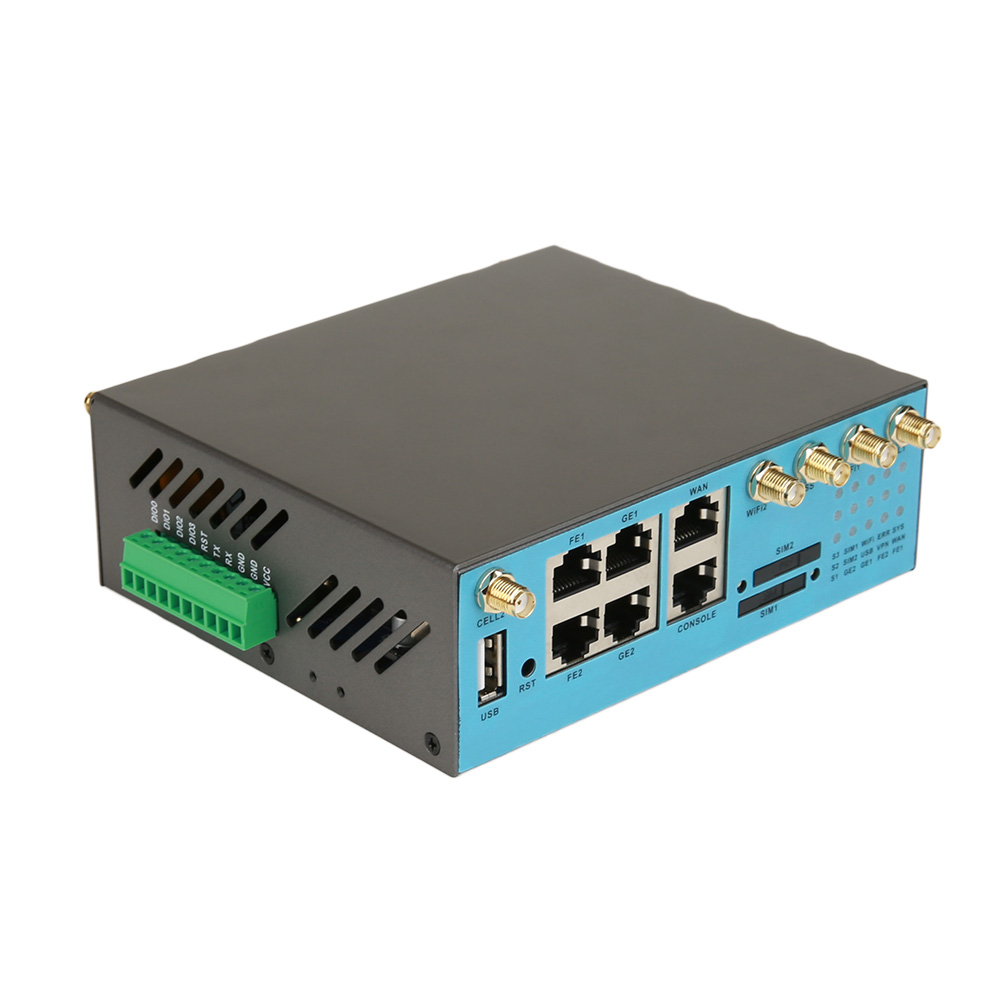
H900f as a Communications Gateway for PV Projects
Within the E-Lins portfolio, the H900f Gigabit 5G Industrial Router is positioned for high-bandwidth, low-latency industrial IoT connectivity.
Its key characteristics relevant to photovoltaic monitoring include:
Requirement H900f capability Cellular network 5G SA/NSA dual-mode Mobile redundancy Dual SIM hot backup Local networking Gigabit Ethernet Field-device power PoE++ support Secure communication VPN support Remote management Support for centralized management Industrial operation Wide-temperature industrial hardware Application model Hardware with cloud-edge collaboration The Gigabit network interface can provide local connectivity for multiple devices, while the 5G connection handles remote backhaul.
The dual-SIM architecture provides a second cellular path for projects where communication continuity is important.
PoE++ can also be useful where compatible network cameras or other Ethernet devices are deployed at the same site. This provides an opportunity to simplify field cabling while retaining the industrial networking role of the router.
Where an Industrial 5G Router Fits in Different PV Deployments
Not every photovoltaic site has the same communications requirements.
Distributed Commercial and Industrial PV
Rooftop installations can be spread across many buildings or facilities. A cellular router can provide an independent communications path where fixed network access varies from one site to another.
Remote Solar Plants
Large land-based PV installations may be far from conventional IT infrastructure. Cellular backhaul can connect local monitoring equipment to a central operations platform.
Hybrid Renewable Energy Sites
Where PV is combined with other energy assets, the network may need to connect additional meters, controllers, battery systems, or monitoring devices. A flexible industrial gateway can serve as a common communications point.
Temporary or Newly Commissioned Solar Sites
A cellular connection can also be useful during project commissioning, testing, or temporary monitoring before a permanent communications infrastructure is completed.
The appropriate configuration depends on cellular coverage, site topology, connected devices, data volume, cybersecurity requirements, and the monitoring platform being used.
A Practical Checklist for PV Monitoring Projects
Before selecting an industrial 5G router, project engineers should document the complete communication requirements.
Start with the field equipment. Identify the number of inverters, meters, sensors, data loggers, cameras, PLCs, and edge devices that need connectivity.
Then check the interfaces. Determine whether the equipment uses Ethernet, RS232, RS485, Modbus, TCP/IP, or another supported communication method.
Next, evaluate the cellular environment. Verify 5G and 4G coverage at the actual site rather than relying only on general coverage maps.
The router’s reliability functions should also be reviewed. For a remote installation, dual SIM, watchdog mechanisms, link self-healing, and remote management can have a direct impact on maintenance.
Finally, consider how the network will be managed after installation. A router suitable for one site may become difficult to maintain when hundreds of PV sites are deployed without centralized management.
Why the Communications Layer Deserves More Attention
Photovoltaic monitoring is ultimately a data-driven operation.
A monitoring platform can only analyse information that reaches it. If the network connection is unstable, the problem may not be immediately visible from the solar panels or inverter itself. A communications failure can simply appear as missing data, delayed information, or loss of remote access.
This is why the choice of an industrial 5G router for photovoltaic power monitoring should be based on more than headline 5G speed.
The better selection process considers the complete path from the inverter and sensor to the monitoring platform: industrial interfaces, cellular redundancy, network capacity, environmental protection, VPN security, remote management, and long-term maintenance.
Conclusion
The role of an industrial router in a photovoltaic project is to keep the monitoring and communications layer connected to the equipment generating the data.
For remote solar assets, a 5G industrial router for photovoltaic power monitoring can provide high-speed cellular backhaul while supporting industrial Ethernet, field-device integration, secure remote communication, and centralized management.
E-Lins Technology is focused on industrial M2M and IoT wireless communication equipment for unattended and distributed environments. Shenzhen E-Lins Technology Co., Ltd., established in Shenzhen in 2012 with industrial roots dating back to 1999, serves customers across more than 150 countries and regions. Its industrial networking portfolio covers 4G and 5G routers, industrial modems and DTUs, with applications including power and energy, intelligent transportation, industrial automation, environmental monitoring, and smart-city infrastructure.
For photovoltaic system integrators and operators, the practical objective is not simply to connect a solar plant to the internet. It is to build a communications path that can reliably carry operational data, support remote maintenance, integrate with existing industrial equipment, and remain manageable as the number of solar sites grows.
That is the role an industrial 5G gateway can play in a modern PV monitoring architecture: not just a cellular access point, but the communications foundation connecting distributed solar assets with the monitoring systems that operators depend on.
https://e-lins.com/
Shenzhen E-Lins Technology Co., Ltd. -
-
AuthorPosts

- You must be logged in to reply to this topic.