- This topic is empty.
-
AuthorPosts
-
2026-11-18 at 1:47 pm #90072
“High reliability” appears on almost every industrial gateway brochure. It becomes meaningful only when it is turned into numbers: how many hours a year a gateway is expected to be offline, how often it fails, and how long it takes to bring back online. Those numbers depend partly on the network and the installation, but a large share is decided before the gateway leaves the factory.
This article starts with the arithmetic of availability, shows why repair time matters as much as failure rate, and then sets out seven layers that a high-reliability 5G gateway factory must get right. E-Lins figures and field results illustrate each layer.
The Arithmetic of Availability
A year has 8,760 hours. Availability percentages translate into downtime as follows:
Availability
Downtime per year
Roughly
99%
87.6 hours
Three and a half days
99.5%
43.8 hours
Almost two days
99.9%
8.76 hours
About a working day
99.99%
52.6 minutes
Under an hour
Across a fleet, the differences add up. A network of 1,000 gateways at 99.5% availability loses 43,800 gateway-hours a year, the equivalent of five gateways offline for the entire year. At 99.9%, that falls to the equivalent of one.
Failure Rate and Repair Time
Availability depends on two quantities: how often a gateway fails, and how long each failure lasts. Consider a remote site that suffers two incidents a year. If each requires a site visit and takes 24 hours to resolve, the site loses 48 hours, and availability is about 99.45%. If the same two incidents are resolved remotely within an hour each, the site loses two hours, and availability rises to about 99.98%.
The lesson is that reducing repair time can be as powerful as reducing failures. A high-reliability gateway is one that fails rarely and, when something does go wrong, can be diagnosed and recovered without a journey.
Seven Layers of Reliability
Layer 1: Components and protection
Reliability begins with parts chosen for the worst day rather than the average one, and with protection against the electrical stresses of real sites. E-Lins specifies industrial-grade components rated from -35°C to +75°C, 15KV ESD protection, and 1.5KV electromagnetic isolation, with protection against transients, reverse polarity, over-current, and over-voltage.
Layer 2: Production consistency
A design is only as reliable as the thousandth unit built from it. Owning production allows a factory to control component sourcing, assembly processes, and changes. E-Lins produces in its own SMT factory and assembly lines in Shenzhen under ISO 9001 quality management, with a monthly capacity of tens of thousands of units.
Layer 3: Self-recovery in firmware
Many incidents are not hardware failures but software or link states that need a restart. Hardware watchdog timers and link self-healing let a gateway recover without anyone noticing. E-Lins builds both into its routers and develops its system software entirely in-house.
Layer 4: Link redundancy
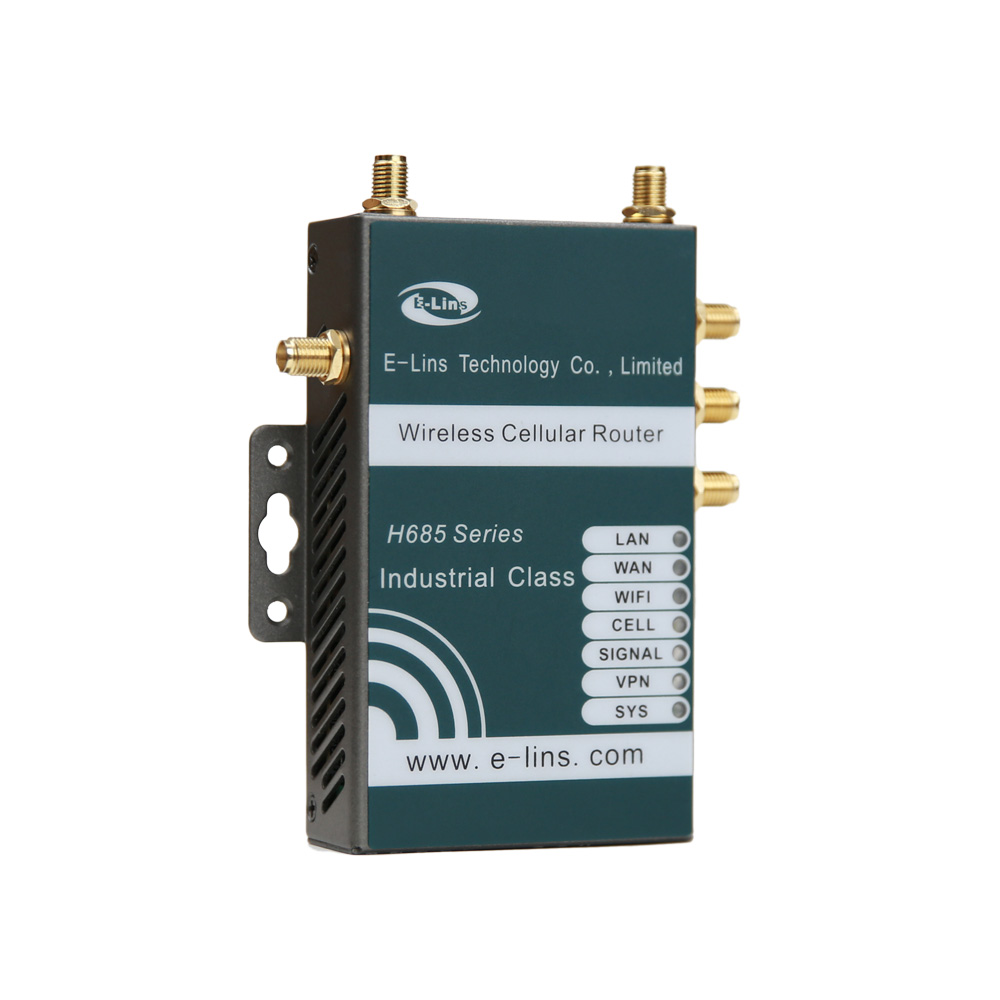
A single operator outage should not take a site offline. E-Lins 5G options include dual SIM hot backup with failover within seconds on the H900f, multi-link failover, load balancing and bonding across cellular, wired WAN and Wi-Fi client links on the H900f IoT 5G modem, and RedCap with 4G failover on the H900pfrc modem.
Layer 5: Power redundancy
Power problems cause many apparent connectivity failures. Dual power inputs with automatic failover, as on many E-Lins H-series routers, keep the gateway running when one supply fails.
Layer 6: Monitoring
A failure that nobody notices lasts longer. Gateways should report their state continuously. E-Lins routers support SNMP, TR-069 and SSH, and the E-Lins NMS cloud platform provides device status monitoring, parameter management, remote firmware upgrades and statistics.
Layer 7: Support and repair
When a problem needs expert attention, the speed of the manufacturer’s support sets the repair time. E-Lins provides 7×24 remote technical support with an average response time of 10 minutes during business hours, packet capture analysis and remote debugging, and reports that 90% of support issues are resolved remotely. It also reports that its remote management capabilities reduce on-site maintenance costs by 40%.
What the Layers Deliver in the Field
E-Lins reports an equipment online rate of 99.5% or higher across its products, and its documented deployments show what the layers achieve under pressure:
A leading Indian telecom operator: more than 100,000 units at remote base stations, with temperatures up to 48°C and supply voltage fluctuating between 5V and 55V, reaching a 99.4% equipment online rate and cutting per-site maintenance costs by 53%.
A European ground support equipment manufacturer: an online rate of 99.9% or higher on electromagnetically noisy airport aprons, with 85% of faults handled remotely.
A Nordic public transport provider: network interruption reduced to 0.3% in winters down to -32°C, with 90% of faults handled remotely.
A South American gaming equipment manufacturer: a 99.9% data transmission success rate across 25,000 terminals with zero accounting disputes.
Device Availability and Service Availability
One distinction prevents disappointment. Device availability measures whether the gateway itself is working. Service availability measures whether the application can reach its destination, which also depends on operator networks, power at the site, and the central systems. A gateway can be at 99.9% while the service is lower because of an operator outage or a failed head-end. Redundancy in links and power, and monitoring of the full path, close that gap.
Turning Targets Into Contract Terms
An availability target only helps if everyone measures it the same way. Define what counts as downtime, for example, a gateway not reporting to the management platform for more than a set number of minutes, and agree how operator outages, power failures at the site, and planned maintenance are treated. Agree how results are reported and reviewed. Combine this with clear warranty and replacement terms and a pool of spare units, so that a hardware failure is resolved in hours rather than weeks. Written this way, reliability becomes something both buyer and manufacturer can track.
Questions for a High-Reliability 5G Gateway Factory
Which of the seven layers does the factory control itself? What online rate does it report, and across how many units? How are incidents recovered without a visit? What share of support cases are resolved remotely? Which deployments under harsh conditions can it document?
The Factory
Shenzhen E-Lins Technology Co., Ltd. has built industrial cellular equipment since its industrial roots in 1999, reports a 98.5% on-time delivery rate for volume projects, and has been recognised as a high-reliability supplier for major global carrier projects. When choosing a high-reliability 5G gateway factory, translate every promise into downtime hours and repair time, and look for evidence at every layer.
https://e-lins.com/
Shenzhen E-Lins Technology Co., Ltd. -
AuthorPosts

- You must be logged in to reply to this topic.