- This topic is empty.
-
AuthorPosts
-
2026-11-26 at 7:04 pm #90211
Understanding the Role of Busbar Insulators in Modern Power Distribution
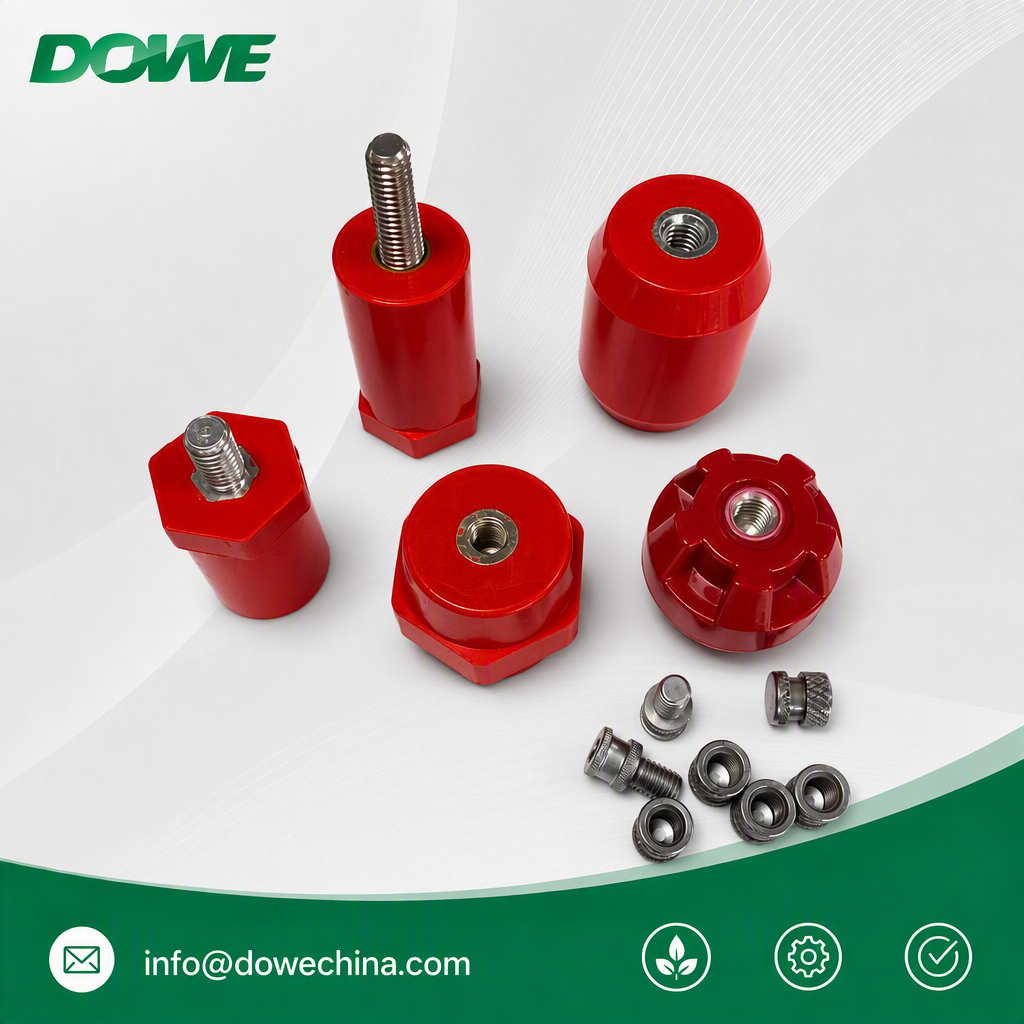
Busbar insulators and standoff supports perform a deceptively simple function: they maintain fixed mechanical spacing and galvanic isolation between current-carrying copper or aluminum busbars and grounded chassis backplates. Yet the engineering behind a reliable busbar insulator is far from simple. Selecting the right insulator requires evaluating dielectric performance, thermal behavior, mechanical load capacity, and flame-retardant properties against the specific operating environment of the switchgear, panelboard, or power electronics cabinet in question.
Yueqing City Duwai Electric Co., Ltd., operating under the DOWE Electric brand (also referenced as DUWAI), has spent over two decades engineering insulation solutions for global power distribution infrastructure. Headquartered in Huangqijia Village, Liushi Town, Yueqing Economic Development Zone, Zhejiang Province, China, the company serves more than 60 countries across Europe, the Americas, the Middle East, Southeast Asia, and Australia. This guide outlines the key selection criteria that panel builders, switchgear OEMs, and EPC contractors should consider when specifying busbar insulators and support systems.
Why Insulator Selection Matters: Industry Pain Points
DC arcing in high-voltage DC solar and battery systems lacks a natural zero-crossing point, which creates continuous surface tracking risks that AC systems do not face in the same way. Short-circuit electrodynamic forces place mechanical stress on busbar supports during fault conditions, and thermal cycling causes differential expansion between copper or aluminum busbars and composite supports. Additionally, non-compliant plastics can ignite during internal arc faults in enclosed switchgear. These pain points define the core criteria that any busbar insulator selection process must address: dielectric withstand, mechanical rigidity, thermal compatibility, and fire safety.
Key Selection Criterion 1: Dielectric and Tracking Resistance
The Comparative Tracking Index (CTI) measures a material’s resistance to conductive carbon tracking caused by surface contamination and humidity. DOWE’s insulation materials achieve a CTI of 600V or higher, placing them in Material Group I, the highest classification for tracking resistance. This is particularly important in humid or dusty solar and battery energy storage system (BESS) installations, where continuous DC voltage without a zero-current crossing makes surface tracking especially destructive.
For medium-voltage applications, partial discharge control becomes critical. DOWE’s vacuum-cast epoxy resin insulators, produced using automated pressure gelation (APG), are void-free and monolithic, controlling partial discharge to less than 5 pC at 1.1 Um. Epoxy volume resistivity exceeds 10^14 Ω·cm, and dielectric loss angle tan δ is no greater than 0.005 at 20°C, properties that matter in harsh, humid, dusty industrial plants, ring main units, and variable frequency drive cabinets.
Key Selection Criterion 2: Thermal Performance
Thermal cycling between copper or aluminum conductors and composite insulation supports creates mechanical stress over the equipment’s service life. DOWE engineers its Coefficient of Thermal Expansion (CTE) to a range of 15–22 × 10^-6 /K, deliberately aligned with copper’s 16.5 × 10^-6 /K and aluminum’s 23.1 × 10^-6 /K, minimizing differential expansion stress. Heat Deflection Temperature (HDT) performance maintains structural rigidity under a 1.8 MPa flexural load up to +140°C for new energy applications, which is essential for battery racks and lithium containers that experience continuous thermal loading. The company’s Relative Thermal Index (RTI) is certified at 130°C per UL 746B for electrical and mechanical properties.
Key Selection Criterion 3: Mechanical Load Capacity
Busbar insulators must resist electrodynamic short-circuit repelling forces without mechanical failure. DOWE’s busbar support and clamping systems are rated up to 1,100V AC and 6,300A, with the HC Heavy Duty series engineered for short-circuit withstand (Icw) up to 100kA for one second, suited to utility substations and high-current industrial installations. Tensile pull-out resistance exceeds 8,000 N for M8/M10 threaded inserts, and torsional lock exceeds 1.5 times the bolt proof torque, which protects against rotational shear stress during installation. For applications with hexagonal anti-rotation bases, such as the SB/JYZ series, assembly technicians can hold the base with an open-end wrench while applying full tightening torque, preventing damage to the mounting plate.
Key Selection Criterion 4: Fire Safety
Non-compliant plastics can ignite during internal arc faults inside enclosed switchgear, making flame retardancy a non-negotiable selection criterion. DOWE’s materials carry UL 94-V0 self-extinguishing flame retardancy certification, with afterflame time t1 + t2 no greater than 8 seconds and zero flaming drips. This directly addresses fire safety requirements relevant to battery energy storage system installations.
Matching Insulators to Voltage Class and Application
Selection should begin with the system voltage class. DOWE’s low-voltage standoff insulator series covers 660V to 1,000V AC and includes the SM Series for standard switchgear and motor control centers, the SB/JYZ Series engineered for high-voltage DC systems up to 1,500V DC in solar PV, BESS, and EV charging applications, the SEP Series for high-vibration industrial machinery and mining power boxes, the MNS Series for drop-in OEM replacement in ABB MNS drawer-type cabinets, the CT/CJ Series for multi-tier layered busbar arrangements, the D/C/EN Series for European-style panels and railway trackside power, and the TSM/MG Series for miniature applications such as relay boards and smart meter boxes.
For higher voltage applications, the Medium-Voltage Insulator Series spans 3.6 kV to 12 kV AC, including the DW Series for clean indoor switchgear and secondary distribution substations, and the EL MV Series using vacuum-cast epoxy resin for harsh, humid, dusty environments.
OEM Replacement Considerations
Many panel builders need exact dimensional matching when replacing aging switchgear components without redesigning the panel. DOWE offers 1:1 drop-in OEM replacement with precision dimensional matching for ABB MNS, Schneider Blokset/Okken, Siemens Sivacon, GE, and Eaton switchgear platforms. The EL-130, EL-170, and GCK series are designed to match original mounting hole centers, busbar slot spacing, and creepage dimensions without panel redesign.
Verification and Compliance
DOWE’s materials and components comply with IEC 61439-1/2, IEC 60664-1, IEC 60273, IEC 60071, and IEC 60815, along with UL 94-V0 flammability certification, RoHS and REACH environmental compliance, CE clearance, SGS third-party type test clearance, and UL 746B Relative Thermal Index certification. Panel builders can reference DOWE’s third-party SGS type test reports to complete Design Verification documentation without conducting independent destructive testing.
Conclusion
Choosing the correct busbar insulator requires balancing dielectric performance, thermal compatibility, mechanical strength, and fire safety against the specific demands of the application, whether that is a standard low-voltage switchgear panel, a high-voltage DC solar inverter, a utility substation, or a medium-voltage ring main unit. With production capacity greater than 500,000 low-voltage standoffs per month and annual exports of millions of SB/JYZ insulators to solar inverter OEMs, battery pack integrators, and switchgear builders worldwide, DOWE Electric provides engineered structural insulation and OEM/ODM manufacturing capability for electrical panel builders, switchgear OEMs, and EPC contractors navigating these selection decisions.
http://www.busbarinsulator.com
Yueqing City DUWAI Electric Co.,LTD -
AuthorPosts

- You must be logged in to reply to this topic.