- This topic is empty.
-
AuthorPosts
-
2026-03-02 at 2:04 pm #87817
High-capacity NMC cylindrical cells have become a cornerstone technology in modern energy storage systems, powering applications that range from electric vehicles (EVs) and hybrid electric vehicles (HEVs) to stationary energy storage systems (ESS), power tools, and e-mobility devices. As global electrification accelerates and renewable energy integration deepens, the demand for lithium-ion batteries with higher energy density, longer cycle life, and improved safety continues to grow.
Among the various lithium-ion chemistries, lithium nickel manganese cobalt oxide (NMC) has emerged as one of the most versatile and commercially successful cathode materials. When paired with cylindrical form factors such as 18650, 21700, or 4680 formats, NMC cells offer an optimized balance between energy density, mechanical stability, manufacturability, and thermal management.
This article provides a comprehensive analysis of the cycle life performance of high-capacity NMC cylindrical cells. We explore degradation mechanisms, influencing factors, testing methodologies, performance modeling, and strategies to extend service life. The goal is to provide a technically grounded understanding suitable for battery engineers, system integrators, and procurement professionals.
1. Overview of NMC Chemistry in Cylindrical Cells
1.1 Composition and Structure
NMC cathodes are layered transition metal oxides with the general formula LiNixMnyCozO2. By adjusting the ratio of nickel (Ni), manganese (Mn), and cobalt (Co), manufacturers can tailor performance characteristics:
-
Higher nickel content: increased energy density but reduced thermal stability.
-
Higher manganese content: improved structural stability and safety.
-
Higher cobalt content: enhanced electronic conductivity but higher cost.
Common compositions include NMC111, NMC532, NMC622, and NMC811. In high-capacity cylindrical cells, NMC622 and NMC811 are frequently used to achieve higher gravimetric and volumetric energy densities.
1.2 Advantages of Cylindrical Form Factor
Cylindrical cells provide several advantages:
-
Robust mechanical structure under internal pressure.
-
Efficient heat dissipation through uniform geometry.
-
Mature manufacturing infrastructure.
-
Lower risk of swelling compared to pouch cells.
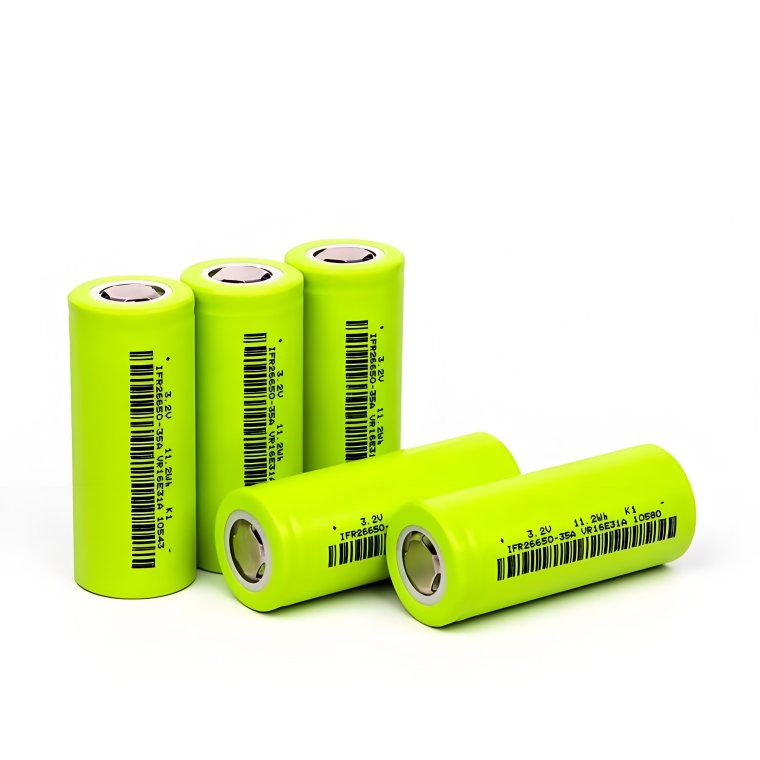
These characteristics contribute to consistent cycle performance and predictable degradation behavior, which are critical for long-term reliability.
2. Defining Cycle Life
Cycle life refers to the number of charge-discharge cycles a battery can undergo before its capacity drops to a defined threshold, typically 80% of initial capacity (End of Life, EOL).
2.1 Capacity Fade Metrics
Cycle life evaluation often involves:
-
Capacity retention (%)
-
Internal resistance growth (mΩ increase)
-
Coulombic efficiency
-
Energy retention
For high-capacity NMC cylindrical cells, cycle life may range from 800 to over 2000 cycles depending on operating conditions, depth of discharge (DoD), and temperature.
3. Degradation Mechanisms in High-Capacity NMC Cylindrical Cells
Understanding degradation mechanisms is essential for cycle life optimization.
3.1 Cathode Degradation
3.1.1 Structural Phase Transitions
High-nickel NMC materials are prone to structural instability during repeated lithium intercalation and deintercalation. Repeated cycling can cause:
-
Layered-to-spinel or rock-salt phase transitions
-
Microcrack formation
-
Particle fragmentation
These structural changes reduce lithium mobility and increase impedance.
3.1.2 Transition Metal Dissolution
Manganese and nickel dissolution into the electrolyte can occur at elevated temperatures or high voltages. Dissolved metals migrate to the anode, degrading the solid electrolyte interphase (SEI).
3.2 Anode Degradation
3.2.1 SEI Growth
The solid electrolyte interphase (SEI) forms on the graphite anode surface during the first charge cycle. While initially protective, continuous SEI growth during cycling consumes lithium inventory, leading to:
-
Irreversible capacity loss
-
Increased impedance
-
Reduced power capability
3.2.2 Lithium Plating
Under high charge rates or low temperatures, lithium plating can occur on the graphite surface instead of intercalating into the anode. This accelerates capacity fade and poses safety risks.
3.3 Electrolyte Decomposition
Electrolyte oxidation at high voltages contributes to gas generation, increased internal pressure, and impedance growth. In cylindrical cells, the rigid metal casing helps contain pressure but does not eliminate degradation.
3.4 Mechanical Stress and Fatigue
Repeated expansion and contraction of electrode materials during cycling generate mechanical stress. In high-capacity cylindrical cells with dense electrode packing, stress concentration can:
-
Induce electrode delamination
-
Crack current collectors
-
Increase contact resistance
4. Factors Affecting Cycle Life
4.1 Depth of Discharge (DoD)
Cycle life is inversely related to DoD:
-
100% DoD: shorter cycle life
-
80% DoD: moderate cycle life
-
50% DoD: significantly extended life
Partial cycling reduces mechanical strain and limits voltage extremes.
4.2 Operating Temperature
Temperature plays a critical role:
-
High temperature (>45°C): accelerates chemical degradation.
-
Low temperature (<0°C): increases lithium plating risk.
-
Optimal range: 15–35°C for most NMC cylindrical cells.
4.3 Charge and Discharge Rates (C-Rate)
High C-rates increase:
-
Internal resistance heating
-
Lithium plating probability
-
Mechanical stress
Slower charging (e.g., ≤0.5C) generally enhances cycle life.
4.4 Upper Cut-Off Voltage
High-capacity NMC cells often operate up to 4.2–4.3V. However:
-
Higher voltage increases energy density.
-
Higher voltage accelerates electrolyte oxidation and cathode degradation.
Reducing upper cut-off voltage by 0.1V can significantly extend cycle life.
5. Cycle Life Testing Methodologies
5.1 Standard Testing Protocols
Cycle life testing typically involves:
-
Constant current–constant voltage (CC-CV) charging
-
Constant current discharging
-
Periodic capacity checks
Standards such as IEC 61960 and UL testing frameworks define general testing procedures.
5.2 Accelerated Aging Tests
Accelerated testing involves:
-
Elevated temperature cycling
-
High C-rate stress testing
-
High voltage holds
While useful for rapid comparison, accelerated tests must be interpreted carefully, as they may not perfectly represent real-world conditions.
5.3 Calendar Life vs Cycle Life
Calendar aging occurs even without cycling. For high-capacity NMC cylindrical cells stored at high state of charge (SOC), degradation continues due to electrolyte oxidation and SEI growth.
A complete life analysis must integrate both cycle aging and calendar aging effects.
6. Modeling Cycle Life
6.1 Empirical Models
Empirical models use:
-
Capacity fade curves
-
Resistance growth data
-
Statistical regression
These models are simple but limited in extrapolation beyond test conditions.
6.2 Electrochemical Models
Physics-based models simulate:
-
Lithium diffusion
-
SEI growth kinetics
-
Thermal effects
Such models enable predictive life analysis but require detailed material parameters.
6.3 Data-Driven Approaches
Machine learning and big data analytics are increasingly used to predict cycle life from early-cycle performance indicators. Features such as voltage hysteresis and impedance growth trends can predict long-term degradation.
7. Strategies to Improve Cycle Life
7.1 Material Optimization
-
Surface coatings (e.g., Al2O3) on NMC particles.
-
Gradient cathode structures to reduce surface stress.
-
Advanced electrolyte additives to stabilize SEI.
7.2 Cell Design Optimization
-
Improved tab welding and current collector design.
-
Enhanced thermal pathways.
-
Optimized electrode porosity for uniform lithium diffusion.
7.3 Battery Management System (BMS) Control
Advanced BMS strategies significantly extend cycle life:
-
Adaptive charging algorithms.
-
Temperature-controlled charging.
-
SOC window limitation (e.g., 10%–90%).
7.4 Thermal Management
Efficient cooling systems prevent localized overheating, particularly in high-energy cylindrical cells used in EV battery packs.
8. Application-Specific Cycle Life Considerations
8.1 Electric Vehicles
EV applications demand:
-
High energy density.
-
Long cycle life (≥1500 cycles).
-
Robust fast-charging capability.
Balancing fast charging with degradation control remains a central engineering challenge.
8.2 Energy Storage Systems (ESS)
ESS applications often prioritize:
-
Moderate C-rates.
-
Partial cycling.
-
Extended calendar life.
Cycle life may exceed 4000 cycles under optimized conditions.
8.3 Power Tools and High-Power Devices
High pulse currents accelerate degradation. Here, cell internal resistance and thermal stability are critical performance indicators.
9. Future Trends in High-Capacity NMC Cylindrical Cells
Several technological trends are shaping next-generation cycle performance:
-
Ultra-high nickel cathodes (NMC90+).
-
Silicon-dominant anodes.
-
Solid-state electrolyte integration.
-
Larger cylindrical formats (e.g., 4680) for improved thermal uniformity.
While increasing energy density remains a key goal, achieving longer cycle life without compromising safety is equally important.
Conclusion
Cycle life analysis of high-capacity NMC cylindrical cells requires a multidimensional approach encompassing materials science, electrochemistry, mechanical design, and system-level management. Degradation mechanisms such as cathode structural instability, SEI growth, lithium plating, and electrolyte decomposition collectively determine long-term performance.
Optimizing cycle life involves careful control of operating conditions, intelligent battery management strategies, and continuous material innovation. As electrification expands across transportation, industry, and renewable integration, the demand for durable, high-capacity NMC cylindrical cells will only increase.
A deep understanding of cycle life behavior enables manufacturers and system integrators to design batteries that not only meet energy density requirements but also deliver sustainable, long-term value.
In the evolving battery landscape, cycle life is no longer just a performance metric—it is a defining factor of economic viability and environmental sustainability.
http://www.highstar-lithium.com
highstar -
-
AuthorPosts

- You must be logged in to reply to this topic.