- This topic is empty.
-
AuthorPosts
-
2026-10-08 at 10:21 am #89586
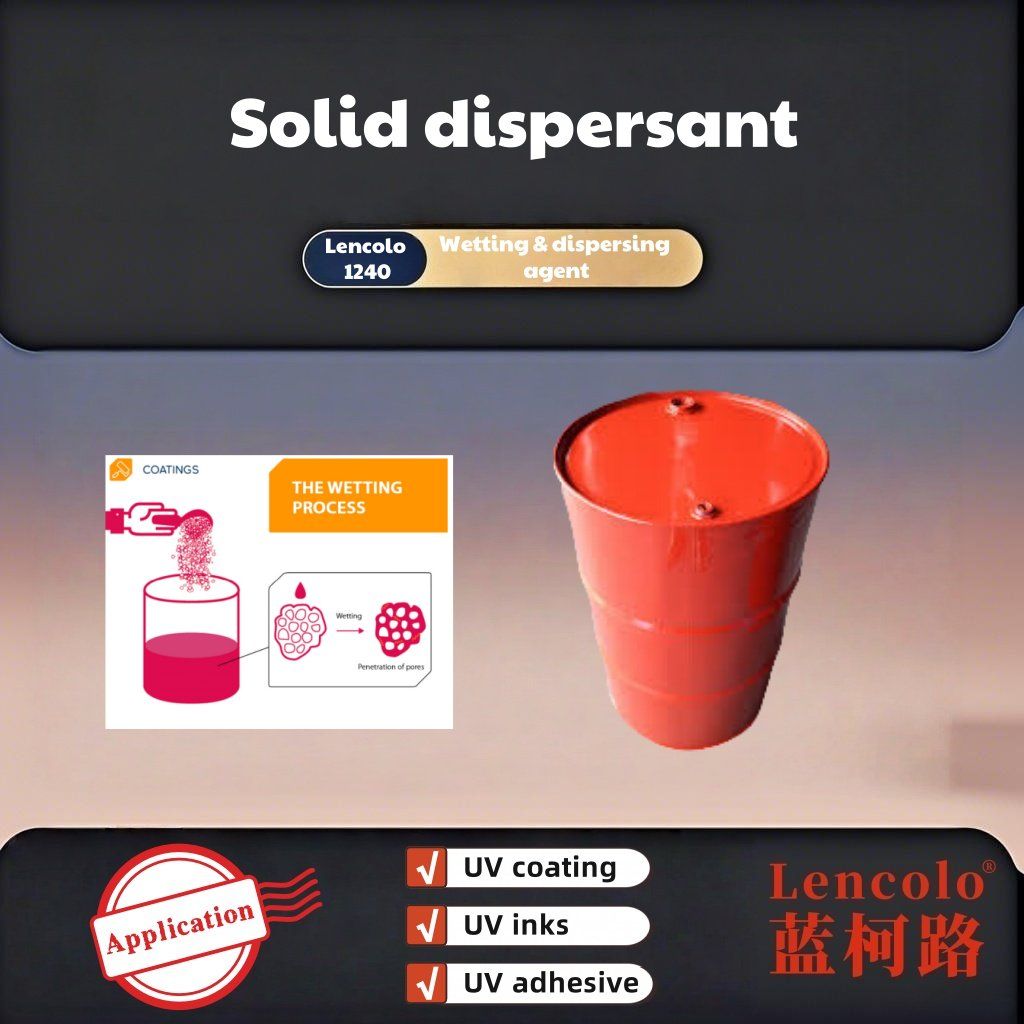
Q: Why is dispersing agent selection important in UV ink?
A: A dispersing agent helps wet and stabilize pigment particles within the UV ink system. If pigment particles are poorly wetted, they can agglomerate or reagglomerate, causing color variation, viscosity changes, sedimentation, poor print quality, and unstable storage.
However, a dispersing agent is only one part of the dispersion system. The UV resin, pigment type, pigment loading, monomer combination, printing process, and substrate can all influence the final result.
Q: Does the UV resin itself affect pigment dispersion?
A: Yes. Some UV resins have good inherent pigment wettability and can contribute to dispersion performance without relying entirely on a separate dispersant.
For example, L-6121 is a low-viscosity UV polyester resin positioned for good pigment wettability. L-6211 is a low-viscosity two-functional UV polyurethane resin that also provides good pigment wettability.
These types of resins can be useful when the formulation needs to combine pigment dispersion with controlled viscosity and suitable cured-film properties.
Q: Should I choose the dispersing system based only on pigment wetting?
A: No. Good pigment wetting does not automatically mean the finished UV ink will perform well.
The ink still needs the correct viscosity for its printing method. UV inkjet, screen, flexographic, and offset inks can have very different rheological requirements.
The cured film also needs to meet the application requirements. For example, L-6105 is a low-viscosity UV polyurethane resin with high flexibility and can be considered when the printed film needs to withstand bending or deformation. If fast curing is more important, L-6111, a low-viscosity UV epoxy acrylic resin, is positioned for fast curing.
This is why dispersing-agent selection should be evaluated together with resin chemistry and the complete ink formulation.
Q: How does the substrate affect the choice of UV ink resin?
A: Substrate compatibility is critical. A pigment can be perfectly dispersed, but the printed film can still fail if adhesion is insufficient.
For glass and hardware applications, L-8400A/8400B is a UV resin positioned for good adhesion. L-6030/6040, a UV pure acrylic resin, is also positioned for adhesion in UV ink applications.
For PET and flexible applications, L-8412A is a UV polyurethane resin for PET with high flexibility.
Therefore, the formulation should be evaluated from both sides: pigment dispersion in the wet ink and adhesion and mechanical performance after curing.
Q: When would I need a dedicated wetting dispersant?
A: A separate dispersant can be useful when the selected resin does not provide sufficient wetting or when particular pigments, matting agents, or powders are difficult to disperse.
Lencolo 1108/1109 are wetting dispersants positioned for matte powder, with good wettability of matte powder as a key characteristic.
The goal should not be to use the highest possible dispersant concentration. Excessive additive can affect viscosity, surface properties, adhesion, or other formulation characteristics. The dosage should be optimized through actual dispersion and stability testing.
Q: Can foam during pigment grinding affect UV ink quality?
A: Yes. High-shear mixing and pigment grinding can introduce air into the ink. Excessive foam may contribute to pinholes, surface defects, filling problems, and inconsistent cured-film appearance.
For UV formulations requiring defoaming, Lencolo 2108 is positioned as a high-efficiency UV defoamer with good compatibility, while Lencolo 2190 is a silicone defoamer with strong defoaming ability.
The defoamer must still be compatible with the dispersion system because excessive surface activity can influence wetting and leveling.
Q: What is the most practical way to evaluate a UV ink dispersion system?
A: Start with the pigment type and loading, then evaluate resin compatibility, initial viscosity, particle dispersion, and printing behavior. After that, check substrate adhesion, curing speed, flexibility, color strength, and long-term storage stability.
A dispersion that looks good immediately after grinding may still become unstable during storage. Changes in viscosity, sedimentation, color, or particle size can reveal problems that are not visible during initial testing.
The key is to treat the dispersing agent, UV resin, pigment, substrate, and curing conditions as one formulation system, rather than searching for a universal dispersant that works for every UV ink.
https://www.lencolo37.com/
Guangdong Lencolo New Material Co., Ltd. -
AuthorPosts

- You must be logged in to reply to this topic.