- This topic is empty.
-
AuthorPosts
-
2026-11-05 at 5:14 pm #89936
Manufacturers assembling multi-layer ultra-thin composites—such as fuel cell membrane electrode assemblies (MEA), flexible printed circuits (FPC), and carbon fiber film materials—routinely face a narrow set of defects that can undermine an otherwise sound design. Air trapped between stacked layers can leave bubbles or voids once lamination is complete. Heating followed by uncontrolled cooling can introduce internal stress that later shows up as springback, warpage, delamination, or blistering. Improper contact during pressing can scratch or misalign films that are often only a few microns thick. And without continuous process data, tracing the root cause of a defect back to a specific production run becomes difficult.
These are the operating conditions that Taihe Machinery’s Servo Vacuum Hot Press Cooling Press is built to address. The equipment combines vacuum degassing, constant-temperature hot pressing, and pressurized water-cooled shaping in a single cycle, aiming to keep multi-layer ultra-thin materials intact through pressing and cooling alike.
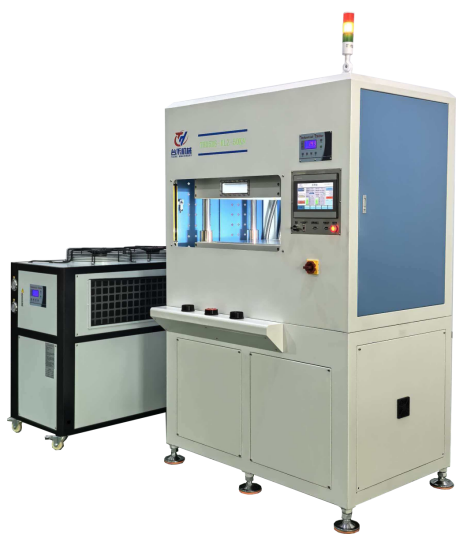
In operation, pre-laminated workpieces are placed between upper and lower heated platens, and closing the chamber forms a sealed space monitored by pressure sensors and temperature probes feeding data to the control system in real time. A vacuum pump then evacuates air trapped between the material layers, with vacuum degree set according to the specific material process. A servo motor, driving a ball screw through a synchronous belt, lowers the upper platen with segment-adjustable descent speed, allowing low-speed soft contact intended to protect ultra-thin films before light pre-pressure fixes the stack against slippage.
During the constant-temperature dwell stage, heating rods built into the platens raise the surface temperature, which is held through PID control with real-time feedback, while servo-driven pressure is maintained through sensor feedback and dynamic compensation. This combination of heat and pressure is intended to soften and bond polymer resin or ionomer interfaces between layers, with dwell time set automatically according to the process recipe. Once dwell is complete, pressure is kept unchanged rather than released, and an internal water-cooling circuit cools the platens so the material solidifies gradually under load. Taihe Machinery states this sustained pressure during cooling is designed to offset cooling shrinkage stress, which can otherwise lead to springback, warpage, delamination, or blistering, and that the cooling rate itself is adjustable to suit different material requirements. Pressure is released and the chamber opened only after the platens reach a preset discharge temperature.
Throughout the cycle, the system continuously records pressure, displacement, and temperature, automatically generating pressure-displacement and temperature-time curves and saving process records. These records can be exported via USB drive or integrated with an MES system, giving production teams a way to trace quality issues back to specific process parameters rather than relying on visual inspection alone.
For manufacturers producing MEA stacks, FPC assemblies, or carbon fiber film laminates, the practical implication is a single platform that addresses degassing, bonding, and dimensional stability within one sealed, data-logged cycle, rather than treating vacuum removal, heating, and cooling as separate, loosely coordinated steps. The adjustable vacuum, segment-controlled descent speed, and tunable cooling rate allow the same machine to be configured across different material stacks, provided process parameters are set and validated for each application.
About Taihe Machinery
Taihe Machinery supplies precision lamination equipment for multi-layer ultra-thin composite materials, with its Servo Vacuum Hot Press Cooling Press designed for applications including MEA membrane electrode assemblies, flexible printed circuits, and carbon fiber film materials. The company integrates servo pressure drive, vacuum sealing, flat panel heating, water-cooled cooling, and data acquisition within a single control system, positioning its equipment for manufacturers that require traceable, repeatable multi-layer lamination processes.
wwww.gdthjx.cn
Taihe Machinery -
AuthorPosts

- You must be logged in to reply to this topic.