- This topic is empty.
-
AuthorPosts
-
2026-09-04 at 6:31 pm #89336
When HVAC contractors and engineering companies work on modern office buildings or commercial facilities with raised access floors, underfloor air distribution can offer a practical alternative to conventional overhead air systems. In these projects, Under Floor VAV terminals have an important job: they need to fit into a limited floor cavity while still providing stable airflow control and convenient access for adjustment and maintenance.
For buyers looking for an Under Floor VAV manufacturer in China, the product itself is only one part of the decision. The factory's manufacturing capability, engineering experience, quality control, product range, and ability to support project-specific requirements are equally important.
Royal Service Air Conditioning is one manufacturer with long-term experience in this field. The company has more than 50 years of HVAC experience covering design-build, installation, repair, maintenance, and air distribution solutions. Its Under Floor VAV range is developed for projects where installation space, airflow control, service access, and system flexibility are important.
Why Under Floor VAV Requires Different Product Design
Underfloor HVAC is not simply a conventional VAV system turned upside down.
The terminal is installed beneath a raised floor, so the available height may be limited. At the same time, the underfloor space is often shared with electrical cables, communication systems, structural supports, and other building services.
This creates several practical requirements for the VAV terminal.
The unit needs to be compact enough to fit the available space. Connections must match the project layout. Airflow needs to be controlled according to the design requirements. Maintenance should also be possible without creating unnecessary work for the contractor.
For this reason, underfloor VAV products should be evaluated based on the actual installation environment rather than only on general airflow specifications.
A China Manufacturer Should Offer More Than a Catalog
China has a large HVAC manufacturing industry, but there is a major difference between a factory that builds air-side equipment and a supplier that simply resells products.
For international contractors and distributors, a capable manufacturer should be able to discuss practical questions such as:
-
What is the minimum available floor height?
-
What airflow range is required?
-
Is the system pressure-dependent or pressure-independent?
-
Is cooling only required, or is heating also needed?
-
What type of floor panel will be used?
-
Where will maintenance access be provided?
-
How will the VAV terminal connect with the control system?
These questions directly affect product selection.
Royal Service combines manufacturing with more than five decades of HVAC design and installation experience, which allows its technical team to consider the terminal as part of a complete air distribution system rather than as an isolated metal enclosure.
Royal Service Under Floor VAV Product Range
Royal Service offers a dedicated Under Floor VAV product range covering several configurations.
The portfolio includes:
-
Underfloor Single Duct VAV Terminals
-
Underfloor Fan Powered VAV Terminals
-
Low Profile Underfloor Fan Powered VAV Terminals
-
Underfloor Fan Coil Units
-
Underfloor Swirl Diffusers
This is useful for project buyers because different areas of the same building may have different HVAC requirements.
A single-duct terminal may work well when the underfloor plenum already provides the required supply air pressure. A fan-powered terminal can be considered where additional fan assistance or specific heating and control functions are required.
Instead of forcing every zone into one product type, the engineer can select the configuration according to the actual space and operating conditions.
RSV-UFDC Underfloor Single Duct VAV Terminal
One of the products in the range is the RSV-UFDC Underfloor Single Duct VAV Terminal.
The UFDC is designed for installation within an underfloor supply-air space. Unlike a conventional overhead terminal, its design takes into account the limited cavity height and the requirement for access from above the floor.
According to the product specifications, the terminal is intended for underfloor air spaces of approximately 12 to 18 inches. The unit uses a 1.2 mm galvanized steel casing, together with extruded aluminum linear grilles.
One of the practical features is the top-access arrangement. The dirt holder and airflow adjuster are located below the floor panel, allowing adjustment and cleaning from above. This can be useful for raised-floor applications because technicians do not necessarily need to gain access from underneath the structural floor.
The product is available in cooling-only as well as cooling-and-heating configurations, with both pressure-dependent and pressure-independent device options. The listed maximum primary airflow range is 216–576 m³/h.
These details are worth considering in actual projects because service accessibility can make a difference after installation, especially in buildings where the area beneath the floor is crowded with other services.
RSV-UFFP Low Profile Fan Powered VAV
Another product designed for space-sensitive installations is the RSV-UFFP Low Profile Underfloor Fan Powered VAV Terminal.
As the name suggests, the unit uses a low-profile configuration for applications where floor cavity height is restricted.
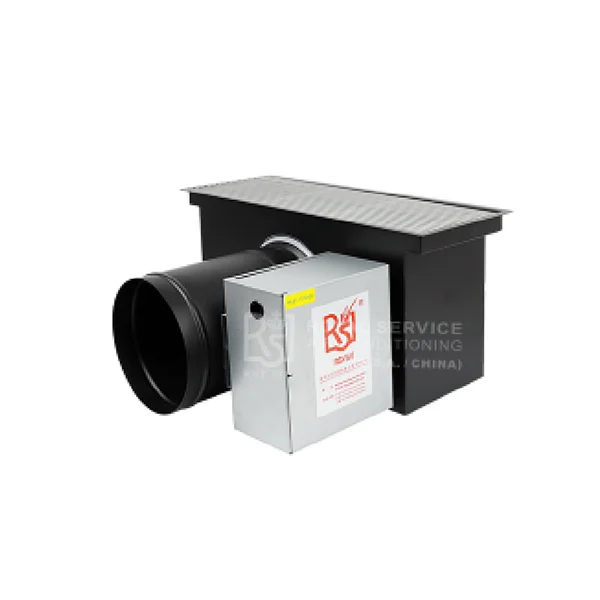
The published specifications for the RSV-UFFP-150 include a 600 × 600 mm panel size and a 150 mm height, with an airflow range of 220–450 m³/h. The unit can be configured for cooling-only or cooling-and-heating applications.
A key feature is the maintenance concept. The design allows standard maintenance access from above the raised floor, which can simplify servicing when the unit is installed in a compact space.
For a project where floor height is one of the main constraints, this type of low-profile terminal can be easier to integrate than a conventional fan-powered VAV product.
Factory Construction Is Worth Checking
When sourcing HVAC products internationally, buyers often focus heavily on published product specifications. That is necessary, but it is not enough.
For underfloor terminals, dimensional consistency can be especially important. A small discrepancy in panel size, connection position, or casing dimensions can create installation problems when the equipment needs to fit into a standardized floor system.
Royal Service's manufacturing operation includes laser machines, CNC machine tools, hydraulic presses, and dedicated production lines. The company also has laboratory and testing facilities and uses dedicated quality inspectors during production.
This factory infrastructure provides an important foundation for repeatable manufacturing.
For distributors and contractors placing repeat orders, the ability to maintain consistent dimensions and production standards can be just as important as the initial product selection.
Galvanized Steel Construction for Underfloor Applications
Material selection deserves attention when evaluating an Under Floor VAV terminal.
The RSV-UFDC uses 1.2 mm galvanized steel for its casing. The RSV-UFFP low-profile model also uses 1.2 mm galvanized steel, with a specified zinc coating weight of 120 g/m².
For equipment installed in an underfloor environment, casing durability is a practical consideration. The terminal must remain rigid enough for installation and routine servicing while fitting within the restricted cavity.
Buyers should also confirm the specific material requirements of their project, particularly for buildings with special environmental or fire-safety requirements.
Airflow Control Should Match the Project
An important mistake in HVAC procurement is choosing a terminal based only on physical size.
The correct model depends on the required airflow, pressure, control method, and room application.
For example, the UFDC provides a listed maximum primary airflow range of 216–576 m³/h, while the RSV-UFFP-150 is listed at 220–450 m³/h.
The project engineer should compare these figures with the actual room load and system design.
Other factors may include:
-
Underfloor plenum pressure
-
Minimum and maximum airflow
-
Floor cavity height
-
Outlet or diffuser arrangement
-
Heating requirements
-
Sound requirements
-
Control strategy
-
Required maintenance access
This type of technical review should take place before the purchase order is finalized.
Why Top Access Matters to Contractors
Maintenance is sometimes overlooked during the design stage because the equipment is hidden below the floor.
In practice, however, technicians still need to inspect, adjust, clean, or service the system after commissioning.
A design that provides access from above the floor can reduce the amount of dismantling required during service.
The RSV-UFDC has an airflow adjuster and dirt holder accessible from above. The RSV-UFFP low-profile model is also designed around above-floor maintenance access.
For facilities managers and contractors, this can be a practical advantage over designs that require difficult access from the underside of the floor structure.
Under Floor VAV for Flexible Building Layouts
One reason underfloor air distribution is attractive for certain commercial buildings is layout flexibility.
Office environments can change over time. Workstations may be moved, meeting rooms may be reorganized, and different areas can develop different cooling requirements.
An underfloor air distribution system can make some of these changes easier to manage because the air distribution infrastructure is located beneath the raised floor.
The VAV terminal then becomes an important control point for individual areas.
This approach is particularly relevant to offices, commercial buildings, technology-oriented facilities, educational buildings, and other projects using raised access floors.
The suitability of the system still depends on the overall building design, floor structure, air distribution strategy, and local project standards.
What Makes a Reliable China VAV Factory?
For an overseas buyer, several questions can help separate a real manufacturer from a general trading supplier.
Ask whether the supplier has its own production facility.
Ask what machinery is used for fabrication.
Ask how incoming materials and finished products are inspected.
Ask whether the company has testing equipment.
Ask whether product dimensions can be customized for a specific raised-floor system.
Ask how technical drawings and installation information are provided.
Ask whether the manufacturer's engineers can support commissioning or troubleshooting.
Royal Service's long-term HVAC background and manufacturing capabilities allow it to provide support beyond shipment of the equipment.
The company has more than 50 years of experience in HVAC design-build, installation, repair, and maintenance. This means its technical discussions can include not only product dimensions but also system design, installation conditions, and operation.
Factory Capability and Customization
Not every underfloor project uses the same floor system.
Different markets may have different panel dimensions, pedestal arrangements, floor cavity heights, diffuser types, and control standards.
This creates a need for some degree of project-based product selection or customization.
A manufacturer with its own production and engineering capabilities is usually better positioned to discuss these requirements.
For Royal Service, customization is part of its broader HVAC approach. The company aims to develop systems and products according to customer requirements rather than treating every project as identical.
For international distributors, this can also be useful when supplying projects in markets with specific engineering practices.
Technical Support for International Projects
A product can be well manufactured and still become difficult to use if the technical support is weak.
For international HVAC buyers, product drawings, installation information, selection assistance, and commissioning support can save considerable time.
Royal Service has established a demonstration and training center that includes VAV equipment and an air-system simulation platform. Its technical teams in China and the United States provide support covering system design, product selection, installation, commissioning, operation, and maintenance.
This is particularly useful for overseas contractors who need to coordinate factory equipment with local engineering and installation teams.
Why Consider Royal Service?
For buyers searching for an Under Floor VAV manufacturer in China, Royal Service offers several factors worth evaluating.
The first is experience. The company has more than 50 years in HVAC.
The second is product coverage. Its Under Floor VAV range includes both single-duct and fan-powered solutions, together with low-profile options and related underfloor air distribution products.
The third is manufacturing capability. The factory uses dedicated production equipment and quality inspection processes rather than relying solely on outsourced manufacturing.
The fourth is technical support. Royal Service works across design, installation, maintenance, and VAV product development, allowing it to support customers beyond the initial equipment order.
These advantages do not eliminate the need for project-specific product selection, but they provide a stronger starting point for international sourcing.
Practical Checklist for Global Buyers
Before ordering Under Floor VAV terminals, a project team should have the following information ready:
Project type: office, commercial building, institutional facility, etc.
Raised-floor height: available installation space below the floor.
Airflow: required minimum and maximum airflow for each zone.
Pressure: operating pressure of the underfloor air system.
Control: local controller, thermostat, BMS integration, or other requirements.
Heating: cooling only or cooling plus heating.
Floor system: panel dimensions and pedestal arrangement.
Maintenance: access requirements for future cleaning and servicing.
Documentation: installation drawings, technical data, and inspection documents.
Providing these details to the manufacturer allows the engineering team to recommend a better-matched configuration and reduces the risk of problems during installation.
Final Thoughts
Under Floor VAV equipment needs to meet two requirements at the same time: it must perform as an HVAC control device, and it must fit into the physical limitations of a raised-floor system.
That is why choosing the manufacturer matters.
Royal Service Air Conditioning combines more than 50 years of HVAC experience with dedicated manufacturing, product testing, engineering support, and a range of Under Floor VAV solutions.
The RSV-UFDC Underfloor Single Duct VAV Terminal offers a practical option for passive underfloor air distribution, with top-access adjustment and cleaning features. The RSV-UFFP Low Profile Underfloor Fan Powered VAV Terminal focuses on compact installation, fan-powered airflow, and maintenance access from above the floor.
For overseas HVAC contractors, distributors, and engineering companies, the best sourcing strategy is to evaluate the entire supplier rather than the product name alone. Factory equipment, quality control, dimensional consistency, airflow performance, customization capability, technical support, and long-term HVAC experience should all be part of the evaluation.
For more information, buyers can review the Under Floor VAV product range and discuss specific airflow, floor-space, control, and installation requirements with Royal Service.
http://www.royalservice.com
Royal Service Air Conditioning -
-
AuthorPosts

- You must be logged in to reply to this topic.