- This topic is empty.
-
AuthorPosts
-
2026-11-11 at 4:37 pm #90001
Published: November 2026 | By Shenglvhong Engineering Team
Most curved elevations do not need curved panels. Setting flat panels at slight angles — faceting, or segmentation — reproduces a curve for 25–35% less, and the decision should be made on geometry rather than taste. Judging segmented aluminum panels vs true curved panels for facade design comes down to one number: the kink angle at each joint. Keep it under about 3° and the curve reads as continuous from normal viewing distance. Push past 8° and every panel edge becomes a visible break, whatever the joint width. This guide gives the threshold, the arithmetic behind it, and the hidden costs that shrink a headline 30% saving to 18–25% net.
The principle is simple. A true curved panel is rolled or stretch-formed to follow the arc, so its surface is continuous. A segmented facade uses flat panels, each rotated slightly against its neighbour, so the arc is approximated by a polygon. Material cost drops because flat panels come off a standard cut-and-fold line at any aluminum panel factory; visual risk rises because the polygon has corners.
1. The Faceting Rule: How Much Curve Can Flat Panels Fake?
Engineers usually open with what is the minimum curve radius for aluminum facade panels, but radius alone decides nothing. A 12,000 mm radius looks perfectly smooth at 600 mm panel width and looks like a polygon at 2,000 mm. The controlling ratio is panel width divided by radius, and it sets two quantities that matter: chord height, which is how far the flat panel sits inside the true arc, and kink angle, the visible break at each joint. Radius tables from any single supplier hide this, because the same radius behaves differently at different module widths.
Both are easy to estimate before any drawing is issued. Chord height h ≈ W² ÷ (8R). Kink angle ≈ W ÷ R, expressed in radians. For a 600 mm panel width:
✅ Radius 1,500 mm — chord height 30 mm — kink angle 23°
✅ Radius 3,000 mm — chord height 15 mm — kink angle 11.5°
✅ Radius 6,000 mm — chord height 7.5 mm — kink angle 5.7°
✅ Radius 12,000 mm — chord height 3.8 mm — kink angle 2.9°
✅ Radius 24,000 mm — chord height 1.9 mm — kink angle 1.4°Three bands fall out of that table. Below 3° of kink, faceting is effectively invisible: the shadow line at the joint disappears into a normal 15–20 mm open joint, and a 1.9 mm to 3.8 mm chord height is smaller than the flatness tolerance the project already accepts. Between 3° and 5°, the result depends on finish and lighting — a matte PVDF and a wide joint hide it, a gloss finish under raking light does not. Above 8°, the polygon is the design, and no specification wording will make it look like a rolled surface. That middle band is where the choice between segmented aluminum panels vs true curved panels for facade design is actually won or lost.
So rather than hunting a spec sheet for what is the minimum curve radius for aluminum facade panels, quote the ratio W ÷ R and check it against the three bands. Halving the panel width halves the kink angle and quarters the chord height, which is why faceting is normally tuned by shrinking the module rather than changing the radius. The trade is direct: twice as many panels means twice as many joints, brackets and linear metres of sealant. That is the first place the saving leaks, and it is why Shenglvhong runs the ratio before quoting either option.
✅ Bottom line: Faceting works when panel width divided by radius stays at or below 0.05, giving a kink angle under 3°. Judge it in a 1:1 mock-up at real viewing distance, never on a screen.
2. Where the 30% Comes From — and Where It Disappears
The 30% is real at panel level and overstated at project level. Reading segmented aluminum panels vs true curved panels for facade design at project scale, a flat 3 mm PVDF panel with stiffeners lands at $22–30/m² FOB from Chinese suppliers in 2026; the same panel rolled to a single curvature runs $35–60/m². Take a 2,000 m² cylindrical elevation: about $56,000 segmented against $90,000 truly curved, a $34,000 gap. Then add back what the flat-panel version needs but the curved one does not.
✅ Corner trims and transition profiles at every kink: $4–6/m², because each joint now needs a purpose-made custom angle rather than a straight cover
✅ Dual sealant lines and a drained joint at the fold: $2–3/m², since the kink is the first place water will find
✅ Denser vertical framing to pick up each rotated panel edge: $5–8/m² installed
✅ Extra shop drawings and setting-out, typically 15–25% more panel typesNet that against the $17/m² headline saving and the real figure usually lands at $9–12/m², or 18–25% of the curved-panel package. The saving is still worth having. It is simply not the number that gets quoted at concept stage, and mismatching the two is how value-engineering conversations turn hostile later.
The second leak is substitution. If you are weighing curved aluminum wall panels vs aluminum composite panels which is better, shape decides before price does. Composite bends to a minimum radius of roughly 15 times its thickness — 45 mm at 3 mm, 60 mm at 4 mm — so it follows a tight single curve easily. It cannot follow compound curvature at all, and mineral-filled A2 cores need heat-assisted bending with a genuine risk of skin cracking or delamination along the fold. Solid aluminum rolls to the same single curvature in 2.5–4 mm and accepts re-coating after forming, which is why a single-curved aluminum panel from a specialist line holds up on exteriors where the panel also carries structural duty. Shenglvhong forms both materials on separate lines, so a like-for-like comparison is available on request.
✅ Bottom line: Quote faceting as 18–25% net, not 30%. If corner trims, dual sealing and denser framing together exceed $10/m², true curved panels are usually the cheaper decision.
Frequently Asked Questions
Q: Can segmented flat panels approximate a double curved surface?
Rarely. A double curved surface changes slope in two directions, so both kink angles have to stay under 3°, which forces a very small module and a joint count that erases the saving. Compound geometry is normally the point where a true double-curved aluminum panel wins outright.Q: At what radius does faceting stop working?
There is no fixed radius — only a ratio. At 600 mm panel width, 12,000 mm radius gives a 2.9° kink and facets invisibly; 3,000 mm gives 11.5° and reads as a polygon. Width divided by radius above 0.05 is the practical cut-off, and suppliers who quote faceting without checking it are guessing.Q: How should faceting be approved?
On a 1:1 mock-up, in the final finish, viewed from the distance people will actually stand at. Gloss surfaces and raking sunlight expose kinks that a matte sample at 500 mm hides, and a mock-up is the only evidence that settles the argument.Q: Is a composite panel ever the better substitute?
When the question is curved aluminum wall panels vs aluminum composite panels which is better, composite is defensible on gentle single curves, interior linings and tight budgets — its 15× thickness minimum radius makes small cylinders easy. For exterior curved walls with structural duty, coating repairability or compound zones, solid aluminum from an experienced manufacturer wins, and Shenglvhong quotes both routes so the trade is visible to the design team.Run a Faceting Study Before You Commit the Elevation
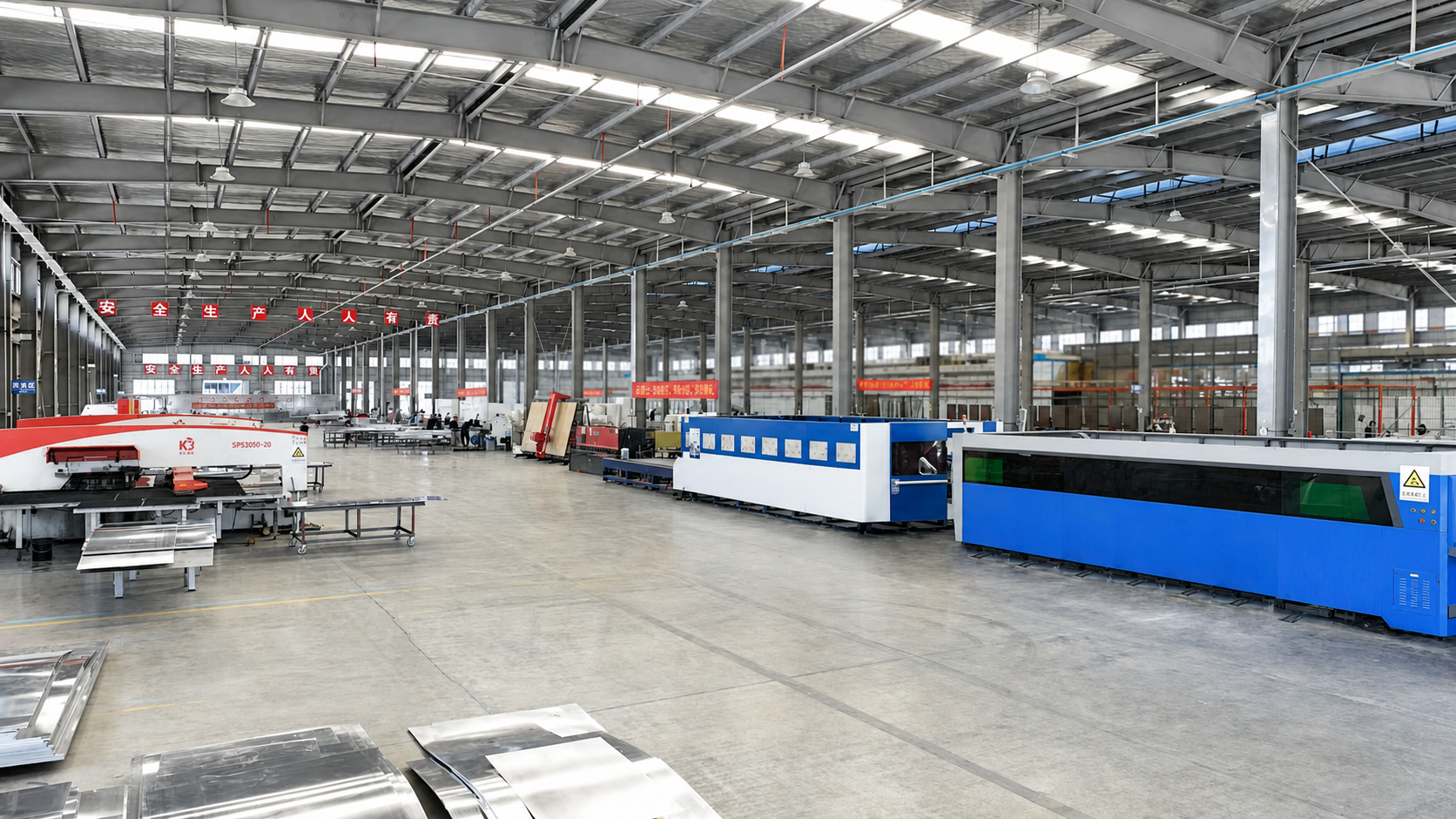
Send the 3D model or elevation drawings to Shenglvhong and the engineering team will return a panelization study marking which zones can be segmented within the 3° rule and which need true curvature.Each study comes with an OEM/ODM price for both schemes. Anhui Shenglvhong Material Technology Group Co., Ltd. produces both options on one line in Chuzhou — laser cutting, CNC forming, roll bending and PVDF coating — so the comparison reflects one line's real numbers rather than two separate estimates.
Typical turnaround is 48 hours for a full elevation, and quotes are issued factory-direct, so the kink-angle map and the price come from the same engineering team.
http://www.saluhtech.com
Anhui Shenglvhong Material Technology Group Co., Ltd. -
AuthorPosts

- You must be logged in to reply to this topic.