- This topic is empty.
-
AuthorPosts
-
2026-11-11 at 2:18 pm #89997
When an electric vehicle runs low on a motorway hard shoulder, in a car park or at a remote site, the rescue team needs charging equipment that is quick to deploy, simple to connect and powerful enough to send the driver on their way. MPMC’s BCH Series offers plug-and-play mobile charging units that carry their own energy, connect to the vehicle through standard CCS2 guns and need no installation, making them a practical tool for roadside rescue and emergency charging providers.
Matching the Unit to the Rescue Task
Compact Units for Cars and Vans
The BCH-80-70 is a compact mobile charger measuring 1,460 x 780 x 1,200 mm and weighing 880 kg. It delivers 80 kW of DC charging from 70 kWh of storage through a liquid-cooled CCS2 gun rated at 260 A, with a 7 m cable that reaches vehicles parked awkwardly at the roadside, and an output range of 200 to 1,000 V for both 400 V and 800 V vehicles. It operates from -20°C to +55°C and at altitudes up to 4,000 m.
Trailer Units for Larger Vehicles and Busy Sites
For vans, light trucks or several vehicles at once, the BCH-275-200 delivers 150 kW through two 250 A CCS2 guns from 203.5 kWh of storage. It rides on a 3.5-tonne heavy-duty trailer and its plug-and-play fast output box eliminates on-site wiring, so the crew can arrive, connect and start charging in minutes.
Its 125 kW of AC output can also power lighting and equipment at an incident scene or a temporary rescue base.
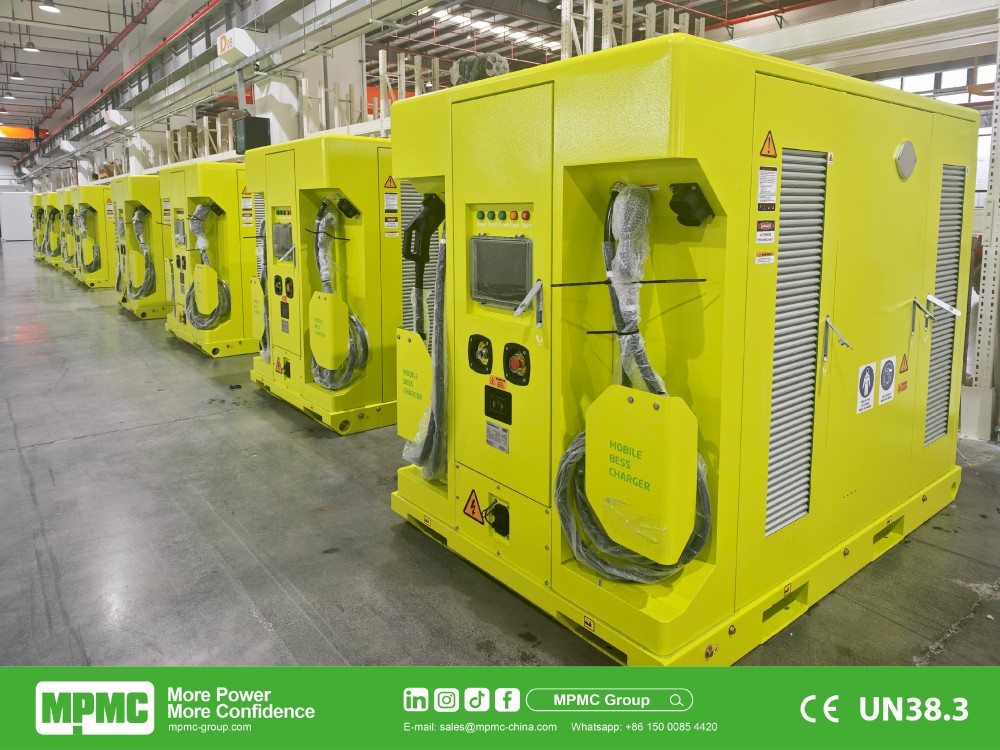
MPMC BCH-275-200 mobile storage and charging unit with its liquid-cooled 2 x CCS2 charging guns.
Table 1. BCH units for rescue and emergency charging
Specification
BCH-80-70
BCH-275-200
DC charging output
80 kW, 1 x CCS2 260 A, liquid-cooled
150 kW, 2 x CCS2 250 A
Storage
70 kWh
203.5 kWh
Output voltage
200-1,000 V
50-1,000 V
Cable length
7 m
3.5 m
Size and weight
1,460 x 780 x 1,200 mm; 880 kg
2,250 x 1,450 x 1,800 mm; 2,800 kg on 3.5 t trailer
Unit recharging
CCS2 DC input, 70 kW
AC input 80 kW; CCS2 DC input up to 150 kW
Operating range
-20°C to +55°C; up to 4,000 m
-20°C to +50°C; up to 3,000 m
Note: The table compares the two models best suited to roadside rescue; the BCH Series also includes the BCH-60-70, BCH-600-400, BCH-800-600 and BCH-500-1000.
Keeping the Service Running Between Call-Outs
Fast turnaround is essential for a rescue service. The BCH-275-200 can refill its battery from a public fast charger through its CCS2 DC input in about one hour, and the BCH-80-70 also recharges through a CCS2 DC input at up to 70 kW, so units can be topped up at a depot or on the road between assignments.
Every BCH charging model runs an EMS with 4G and OCPP 1.6, so dispatch teams can see each unit’s charge level and status remotely, and optional RFID payment supports charging services billed at the roadside. MPMC’s revenue model for the series reflects the premium value drivers place on immediate charging access when they need it most.
CCS2 is standard, and CCS1, GB/T and CHAdeMO can be specified for markets or customers that need them.
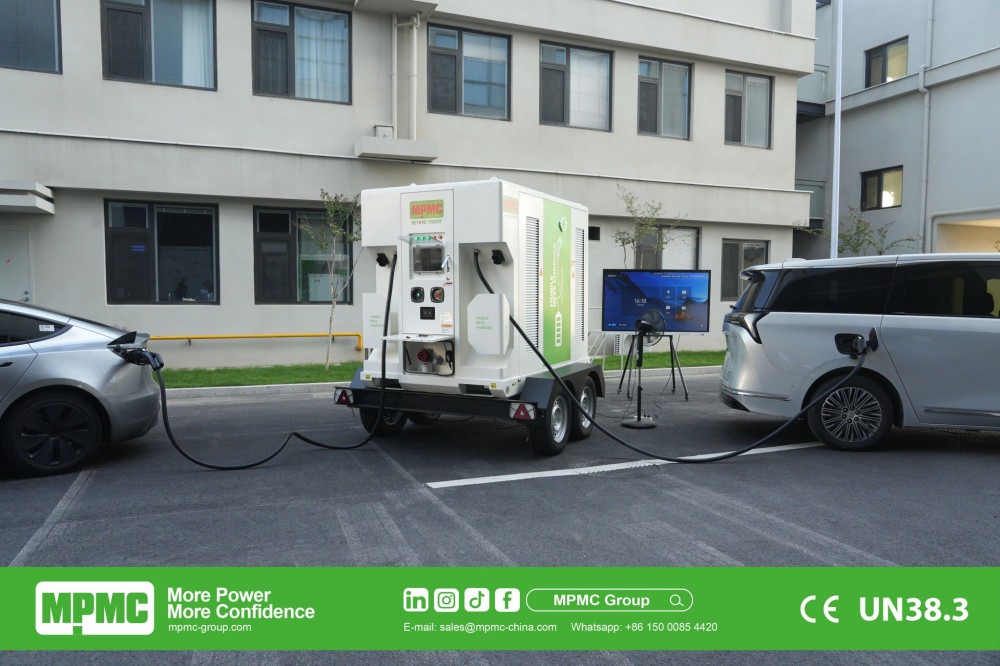
MPMC BCH-275-200 mobile BESS charger on its trailer, fast-charging an electric car.
Dependable Hardware for Unpredictable Work
Rescue units travel constantly and work in all weather. Blade LFP batteries with a sandwich structure tested for fire, water immersion, collision and crushing, rated for 6,000 cycles at 90% depth of discharge and held within 6.7°C by precision thermal control, give consistent output on every call. The BCH-275-200 adds CE-certified aerosol fire protection and a sealed liquid-cooled pack.
Integrated SCADA and EMS allow full remote monitoring and command, so a control room can check battery health and plan maintenance across the whole rescue network.
Table 2. Rescue service needs and BCH features
Service need
BCH feature
Benefit
Reach the vehicle
7 m liquid-cooled cable on BCH-80-70
Charge where the vehicle stopped
Charge any EV
200-1,000 V or 50-1,000 V output; CCS2 standard
Covers 400 V and 800 V platforms
Quick connection
Plug-and-play fast output box (BCH-275-200)
No on-site wiring
Fast unit refill
CCS2 DC input; about 1 h on BCH-275-200
Ready for the next call-out
Dispatch visibility
4G EMS, OCPP 1.6, RFID option
Status and billing in one system
The BCH-80-70 carries a 1-year or 60 MWh system warranty and a 3-year or 200 MWh battery warranty, and the BCH-275-200 a 3-year system warranty and a 5-year battery performance warranty. Six BCH-80-70 units fit in a 20-foot container for efficient delivery to regional bases.
Setting Up Rescue Charging With MPMC
• Define the service area and typical call-out types
• Choose compact or trailer units for each base
• Plan unit recharging at depots and public chargers
• Connect units to dispatch and billing via OCPP 1.6
• Contact MPMC at sales@mpmc-china.com or WhatsApp +86 150 0085 4420 for a rescue charging proposal
https://www.mpmc-group.com/
MPMC Powertech Corp. -
AuthorPosts

- You must be logged in to reply to this topic.